
.svg)









 Affordable Financing
 Fibreglass Pool Install Stages
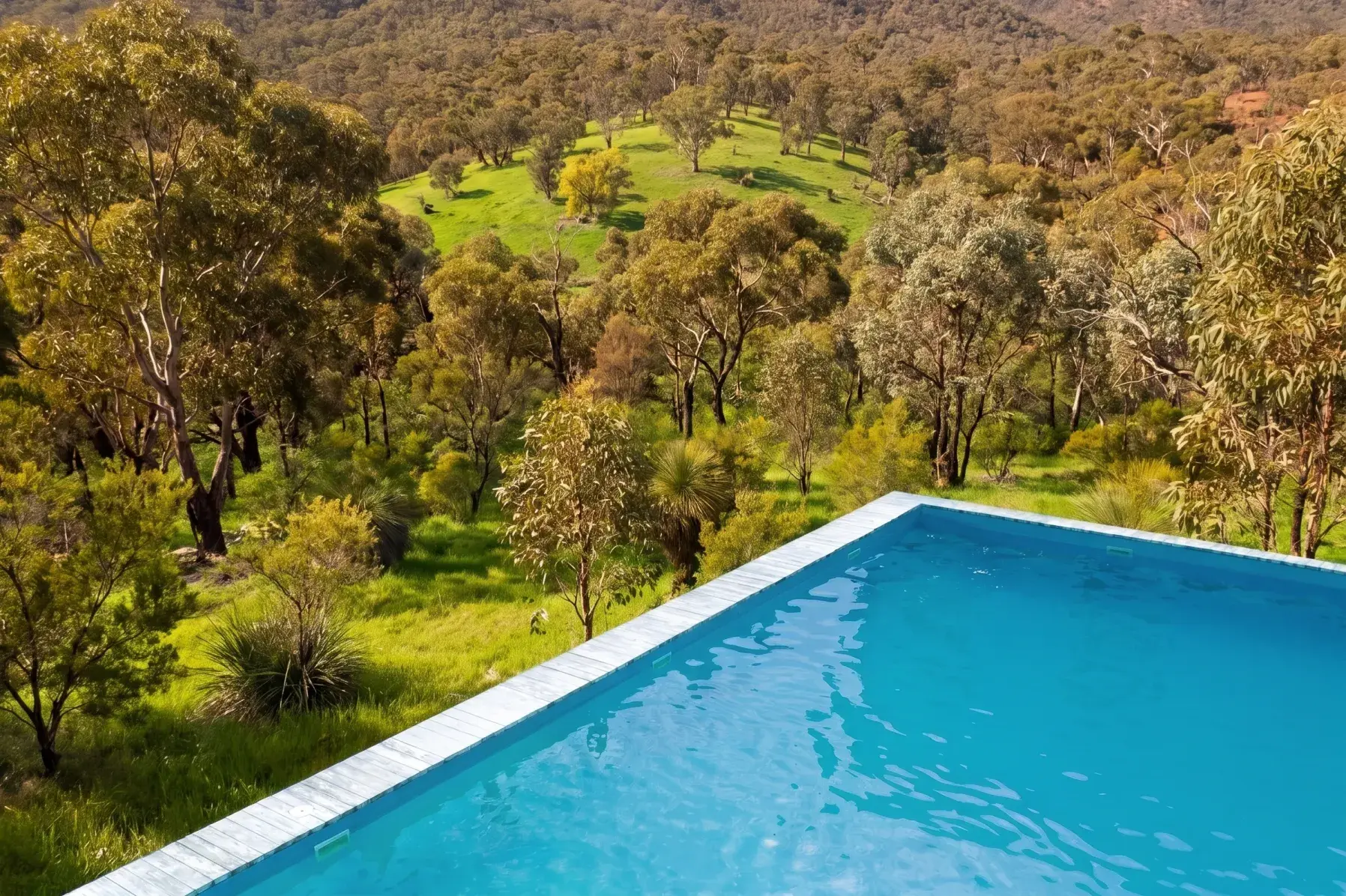
Can you install a fibreglass pool on a sloping block? Yes. The challenge is working out how the pool will be supported, retained and drained.
Depending on the fall of the land, a fibreglass pool can be cut into the slope, partly raised above ground or installed on a fully engineered platform. The right option depends on the slope, soil conditions, site access, pool position and budget.
A sloping site can change several stages of the fibreglass pool installation process, including excavation, retaining walls, drainage, backfill and crane access. Whether you are managing the trades yourself or using a licensed installer, it is worth getting accurate site levels and engineering advice before committing to a pool size or location.
This guide explains the three main ways to install a fibreglass pool on a sloping block, what each option may cost and the practical decisions that can help you avoid expensive site-work surprises.
All retaining, drainage and structural work should be designed and certified by a qualified structural engineer in accordance with local council requirements and applicable Australian Standards.
|
Quick Answer - Can You Install a Fibreglass Pool on a Sloping Block? Yes, a fibreglass pool can be installed on a sloping block. Most installations are either cut into the slope, partly raised or fully raised on an engineered support system. The right option depends on the slope, soil, drainage, access and pool position. As an indicative Australian allowance, a sloping site may add around $3,000 to $20,000 or more for retaining, drainage, structural support and engineering. |
Slope on a residential block is measured as the percentage rise over run from the highest natural ground point to the pool's planned waterline:
-
Under 5% - flat for engineering purposes; standard installation applies
-
5–10% - gentle slope; minor excavation tweaks; no engineered retaining usually needed if the retaining wall height is less than 300mm
-
10–20% - moderate slope; engineered retaining or partly raised pool needed
-
20–35% - steep slope; partly raised or fully raised pool, structural engineering required
-
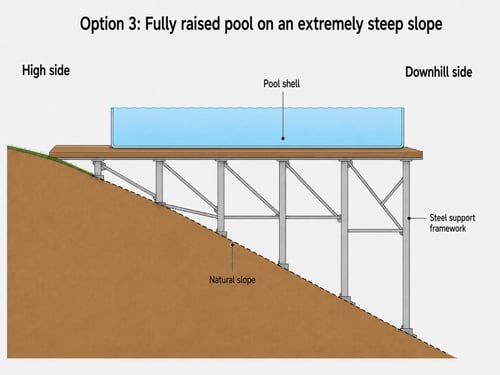
35%+ - extreme slope; fully raised pool with structural platform, often pile foundations
A surveyor's contour plan or a laser-level reading will give you the slope angle before arranging quotes. Don't trust eyeballing as a slope that looks "gentle" from the back deck is often steeper than it looks. The slope angle changes the build category, and the build category changes the price. It is also worth knowing that sloping sites are more likely to encounter shallow rock shelves or bedrock during excavation, as there is often less of an earth layer above the rock.
If you're DIYing, get the contour plan done before you talk pool size. If you're using a licensed local installer, ask whether their first quote was based on contour data or a walk-around. It’s a fair question to ask.
The Three Sloping-Block Configurations
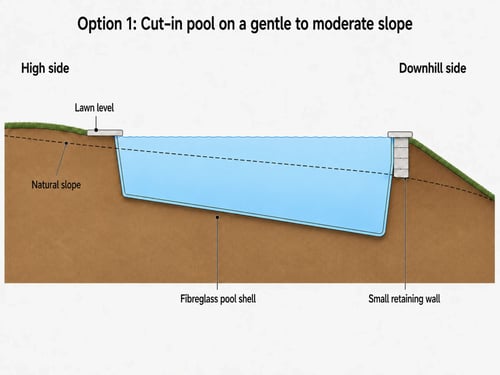
1. Cut-in pool (most common, gentle to moderate slopes). The shell sits in a hole excavated into the high side of the slope, with the waterline at lawn level and the downhill side hidden behind a small retaining wall. From above, it reads as a flat-block pool; the engineering is all on the downhill wall.
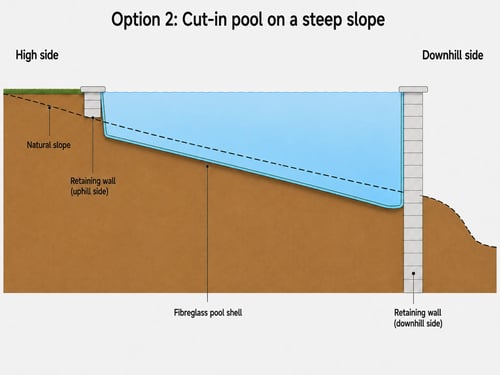
2. Partly raised pool (moderate to steep slopes). The shell sits part in the ground and part above with the upper side is generally less out of the ground and the downhill side rising 1.0m–2.0m above natural ground. The exposed downhill retaining walls can be clad with timber, turned into a green wall or painted to blend it into the landscape or it can be left as is depending on your preference.
3. Fully raised pool (steep to extreme slopes). The shell sits entirely above natural ground on a structural platform. The platform can be manufactured from a variety of materials; however, the key here is to make sure that the material is approved by your structural engineer. In this instance, you will need to install a fibreglass pool that has been specifically designed to be completely above ground without needing backfill to hold the pool walls in place.
Retaining Walls and Engineered Backfill
A pool on a slope almost always needs engineered support on the downhill side. Three common approaches:
-
Reinforced concrete retaining wall which is poured in-situ with steel-reinforcing to the engineer's specs. Strong, slim profile and can be clad to match the home. In 2026, this type of wall costs around $400–$900 per square metre.
-
Concrete block ”besser block” retaining wall is modular concrete blocks that are core-filled with reinforced concrete. In 2026, this type of wall costs around $350–$700 per square metre.
-
Reinforced earth (geogrid) retaining is engineered fill on geogrid layers. Used for taller walls where a poured structure is impractical. In 2026, this type of wall costs around $250–$500 per square metre.
Those per-square-metre figures are a planning indicator only. Your retaining quote will be influenced by the angle of the ground, ease of access for trades and materials and the requirements of your Structural Engineer.
The wall has to do two jobs: hold back the soil that wants to slide down past the pool, and provide a stable base against which the pool's bond beam can be poured. Poorly designed retaining is one of the most common causes of long-term movement and drainage issues on sloping pool sites. Easy to skip past on a flat block, expensive to skip past on a slope.
With the retaining wall in place, the pool shell still needs to be backfilled with cement-stabilised backfill behind the shell as per Australian Standards /NZS 1839:2021.
Drainage: The Quiet Killer on Sloping Sites
Water moves downhill. So does soil, eventually. A correctly designed sloping-block pool has several drainage layers:
-
Subsoil drain on the uphill side of the pool - a perforated 100mm pipe in a gravel trench below ground, commonly known as “ag pipe” or “agricultural drainage pipe”, is used to intercept groundwater before it hits the back of the shell.
-
Subsoil drain on the downhill side of the pool - ag pipe is again used to stop water building up underneath the fibreglass pool shell. If this water is not drained away, the pool can be pushed up out of the ground by the water pressure.
-
Surface water capture - strip drains installed around the pool at the same level as the pool deck or paving prevent rainwater from draining into the backfill and can be piped away from the pool area.
Drainage is the line item buyers most often try to value-engineer out. Taking out drainage might save a few dollars during installation. However, when that beautiful $10,000 retaining wall starts to fail 24 months later, the cost to rectify will have your wallet quivering with fear. Poor drainage is one of the most common contributors to early retaining and structural issues on sloping pool sites. Just remember to spend the money on doing it right the first time.
What Slope Actually Adds to the Cost in 2026
All pricing figures shown are indicative Australian residential construction planning allowances only and vary depending on engineering requirements, site access, location, finishes and contractor pricing. The other big influence is the size and depth of the pool you want to install. As you increase the length, width and depth of your pool, the cost of retaining will also increase.
Slope sits in the "site-specific risk" bucket. On top of a flat-site quote (the kit price $20,000–$40,000 plus the standard trade quotes for excavation, crane, plumbing, electrical and fencing), slope typically adds:
|
Slope category |
Configuration |
Typical slope add-on |
|
5–10% gentle |
Cut-in, minor retaining |
$3,000–$7,000 |
|
10–20% moderate |
Cut-in or partly raised, engineered retaining |
$7,000–$13,000 |
|
20–35% steep |
Partly raised, full retaining + drainage |
$13,000–$20,000 |
|
35%+ extreme |
Fully raised, piled platform |
$20,000+ (engineer-driven) |
These are planning allowances. The actual figures depend on retaining wall length and depth, drainage complexity, access difficulty (sloping blocks usually have access problems too — see access requirements) and the finishes you pick. A simple .5m retaining wall is one thing; a 3.0m high engineered structure is a different project entirely.
How the cost lands for each path
If you're DIYing: the kit price is fixed. The slope add-on lives in your trade quotes - concreter (if required), retaining wall contractor and the structural engineer's fee. You'll get separate line items and pay each trade directly. Your savings come from skipping the builder margin on those line items.
If you're using a licensed installer: the slope add-on lands inside their all-in quote if they offer retaining wall services. Ask for it as a clearly broken-out line, such as "slope and retaining: $X", so it is not buried inside "site works".
When the Smart Move Is to Redesign
Sometimes the cheapest answer to a slope is to move the pool. A 4m shift toward the house can lift the pool out of the steepest portion of the block and cut the cost of retaining from $15,000 to $5,000, for example. That's a Christmas miracle in the world of site costs.
Other shifts that can save you serious money:
-
Smaller pool, same orientation — weigh up the additional costs associated with installing an 8m pool compared to a 6m pool. If there is a big difference in the cost of retaining, consider the smaller pool. You’ll have just as much when summer hits.
-
Flat-bottom plunge pool instead of shallow end/ deep end family pool — most pool owners like the idea of having a nice deep end depth. In a standard below ground installation, there isn’t much cost difference excavating a pool with a shallow end and deep end. If installing into sloping ground, the difference between a 1.8m deep end and a flat bottom pool with a 1.5m depth can be substantial when it comes to retaining walls.
-
Rotate the pool 90° — a long pool perpendicular to the slope is sometimes cheaper than the same pool parallel to the slope (depends on which way the ground falls)
-
Freestanding fibreglass above ground pool — if you really want to avoid expensive excavation and retaining walls, consider installing a fibreglass pool that is designed to be completely freestanding above the ground. On properties with a gentle slop, all you need is a flat earth base that is compacted to 100kPa which cuts the complexity factor down by a lot. On sites with steeper slopes, you will still need retaining however as the pool is completely out of the ground, the retaining will be minimal compared to a pool installed completely in the ground.

Frequently Asked Questions
What's the steepest slope a fibreglass pool can be installed on? Very steep sites beyond 35% can still accommodate pools using engineered structural platforms however a freestanding fibreglass above ground pool will need to be installed. The cost climbs sharply above 35% slope, and the design moves from cut-in to fully raised above the ground.
Do I need a retaining wall for a pool on a sloping block? Almost always, yes. The wall holds back soil on the downhill side and provides the structural surface against which the pool's bond beam is locked. The exception is very gentle slopes (under 5%), where the thickness of the bond beam can be increased to 300mm to act as default retaining.
Is a fully raised pool above the ground more expensive than cut-in? Yes because the structural platform is a substantial extra job. But on extreme slopes, fully raised can sometimes come in under cut-in because a cut-in would need a massive retaining wall. The slope category decides which is cheaper.
Can I DIY a fibreglass pool installation on a sloping block? The shell installs the same way regardless of slope. The retaining walls, cement stabilised backfill and drainage typically need a structural engineer's signed plans, plus the retaining wall contractor to do the job. DIYers usually manage the project and subcontract the structural work however, there is nothing stopping you from building the retaining wall yourself.
Does a sloping block affect the fibreglass pool warranty? Not directly. CFPK's 35-year structural warranty on the shell stands as long as the pool is installed according to the supplied structural plans and AS 1839:2021 Fibreglass Pool Installation.


