
.svg)









 Affordable Financing
 Fibreglass Pool Install Stages
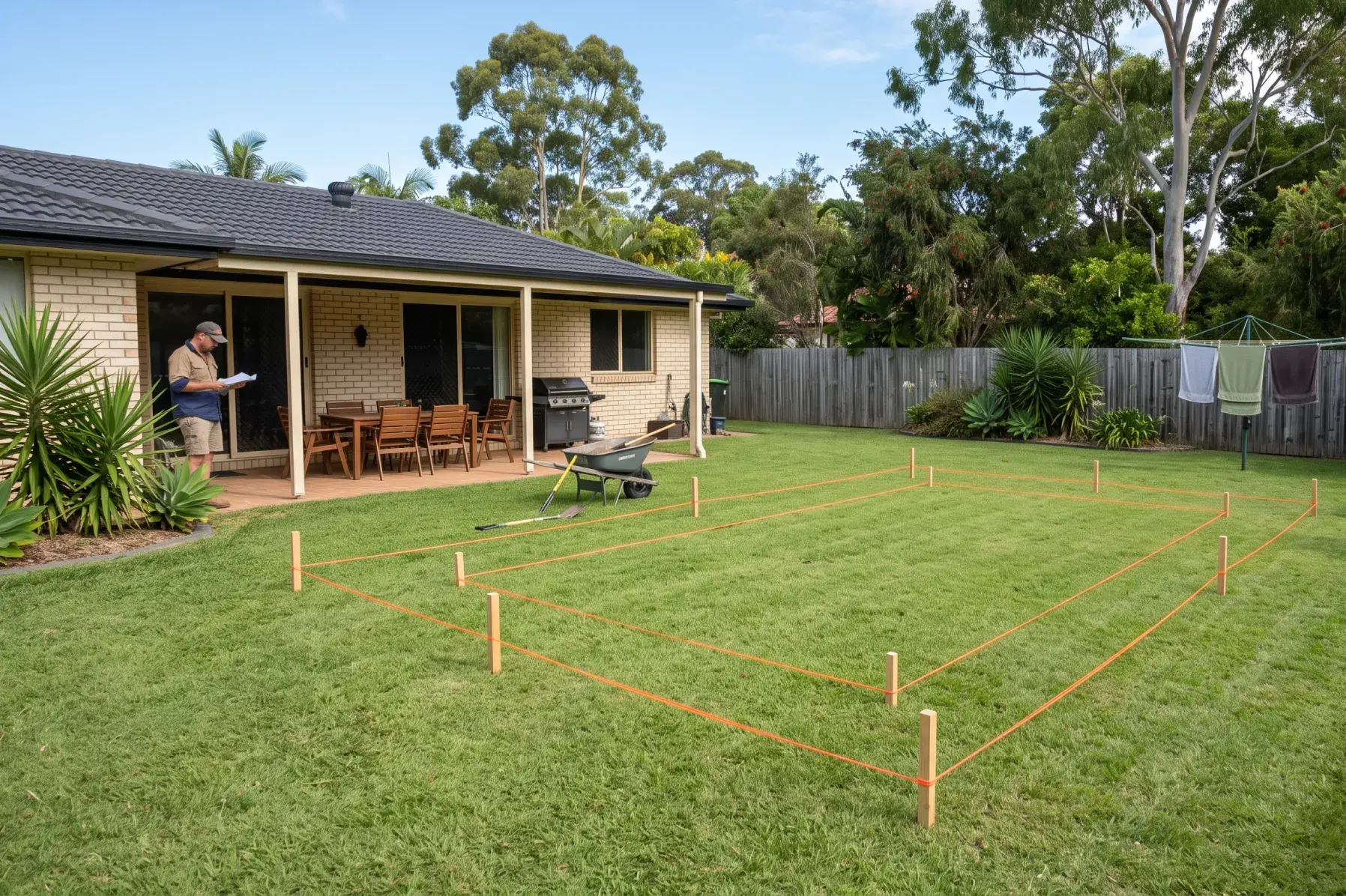
When planning a fibreglass swimming pool installation, you might find that the position you sketched on the back of an envelope isn’t where your pool ends up.
Setbacks, easements, root zones and that sewer line nobody mentioned can all chip away at the “perfect” spot until you land on a position that works both on paper and in the dirt.
Whether you are organising the trades yourself or using an installer, sort out the pool position before falling in love with a particular shell. Plenty of homeowners revisit the size once the boundaries, footings, trees and easements have been checked.
You can usually get a rough idea of what may fit before spending money on detailed plans. Just treat the figures in this guide as starting points, not permission to start digging.
For a wider overview of the installation process, see our Fibreglass Pool Installation Guide.
|
Quick answer: How close can a pool be to a house, fence or tree? As a rough starting point, allow:
These are planning guides, not Australia-wide legal minimums. Your actual pool position will depend on local rules, house footings, tree protection, underground services, pool fencing and construction space. Use these figures to shortlist pool sizes, then confirm the position before ordering the shell. |
Where is a pool setback measured from?
A pool setback may be measured from the waterline, pool shell, excavation edge, coping or safety barrier. It depends on the particular planning, engineering or construction requirement.
This matters because those points are not in the same place.
A seven-metre pool shell may fit on your sketch, but the excavation and finished pool area will be wider.
Whenever someone gives you a setback figure, ask:
-
What is the distance measured from?
-
Is it a planning rule, engineering clearance or construction allowance?
Do not assume that a one-metre waterline setback leaves one metre between the excavation and the boundary fence. That small misunderstanding can be enough to change which pool shell fits.

Why pool setback rules vary across Australia
Australia does not have one set of pool setback rules that applies to every backyard.
Each state has its own approval system, and your council or local planning controls may add property-specific requirements. Flooding, bushfire zones, heritage controls, easements and overlays can also affect what is allowed.
In other words, the pool that fits neatly at your mate’s place two suburbs away may not fit the same way at yours. Backyards are inconsiderate like that.
Your council is usually a good first call. Take your property address, rough sketch and preferred shell size with you. You will get a much more useful answer than simply asking, “How close can my pool be to the fence?”
How close can a fibreglass pool be to a house?
For your first backyard sketch, allow roughly 1 to 1.5 metres between the pool and the house.
The house footing, not just the brick wall you can see, will determine how close the excavation can safely go.
When a pool is dug close to a house, the excavation may remove soil that helps support the footing. Whether that becomes a problem depends on:
-
How deep the pool will be
-
The type and depth of the house footing
-
The soil and slope of the block
-
Nearby retaining walls
-
How much room is needed to build the pool properly
An older home with shallow footings may need more clearance than a newer house with deeper engineered footings.
Unfortunately, the important bit is underground. You cannot always work it out by standing in the yard, squinting at the brick wall and declaring, “She’ll be right.”
When should you speak with an engineer?
Get structural advice if:
-
The pool excavation will be close to the house
-
The pool will sit below a retaining wall
-
The block slopes towards or away from the house
-
You do not know how deep the house footings are
-
Your council, certifier or building surveyor requests engineering
Moving the pool another 500 millimetres away is often much cheaper than engineering a tight position.
How close can a pool be to a side or rear boundary fence?
Around 1 metre from the property boundary is a useful starting point when sketching your pool position, but it is not an Australia-wide minimum.
The distance your property actually needs will depend on your local approval requirements and how the setback is measured.
The space required can also change depending on:
-
Whether there is a retaining wall near the boundary
-
The soil type and stability of the excavation
-
Whether the ground slopes towards or away from the fence
-
Whether the boundary fence will form part of the pool safety barrier
-
How much room is needed for backfill, plumbing and the bond beam
-
Whether machinery and trades can safely work along that side
Confirm the required distance through the pool council approval process before finalising the shell.
The minimum distance may not be the best distance
Even when a pool technically fits within the required setback, it is worth thinking about how that space will work once the pool is finished.
Ask yourself:
-
Is there enough room to walk safely down that side of the pool?
-
Can the kids get past without squeezing between the fence and water?
-
Is there enough room for coping, drainage and future maintenance?
-
Will a garden bed drop soil, mulch and leaves straight into the pool?
-
Can you reach the fence later if it needs repairing or replacing?
-
Will the area feel cramped once the pool fence and landscaping are installed?
A narrow strip may look acceptable on a plan but not be particularly practical to maintain or use. Sometimes moving the pool slightly further from the boundary creates a much better result, even when the approval requirements would allow it closer.
Is the fence actually on the boundary?
Do not assume the existing fence marks the exact legal property boundary. Most fences are close, but older fences can wander. On a tight block, even a small difference may affect which pool shell fits.
A surveyor can confirm the legal boundary when the exact position matters. That is much easier than the neighbour appearing with a tape measure and a concerned look while you are finalising the plans.
Can the boundary fence be used as the pool fence?
Sometimes, but a boundary fence is not automatically a compliant pool safety barrier.
Your council, certifier or building surveyor will look at the fence height, gaps, gates and whether anything nearby makes it easy to climb. That includes trees, sheds, retaining walls, planter boxes and garden beds.
They will also check which side of the fence must remain non-climbable and whether the fence needs to be raised, repaired or replaced.
If the shared fence needs to be changed, speak with the neighbour before the work is planned. That conversation is usually much easier before someone starts discussing fence heights, access and whose dog will end up in which backyard.
How far should a pool be from large trees?
Trees are one of the most underestimated factors in pool placement.
For your first backyard sketch, keep the pool excavation outside the tree canopy and allow roughly another metre. Treat that area as a temporary tree protection zone, with no excavation, soil stockpiles or heavy machinery until an arborist confirms what is safe.
How much room you need will depend on the species, trunk size, age and condition of the tree, as well as where its major roots run. Council-listed or significant trees may also come with extra protection requirements.
For a mature tree with a canopy around 10 metres wide, your rough planning zone may extend 6 to 7 metres from the trunk. That can swallow a fair chunk of a suburban backyard.
Council-significant trees, particularly mature natives, may require an arborist report before approval. Cutting major roots or compacting the soil can weaken or kill the tree, but the damage may not appear for 12 to 18 months.
If the tree is protected, removal or serious damage may also lead to replacement requirements or fines. Confirm early whether arranging the arborist report is your responsibility or the installer’s, because it may be needed before the final pool position can be approved.
Think about what the tree will be like beside the finished pool
Even when the tree can safely remain, consider:
-
Shade across the pool
-
Leaves, bark, flowers or fruit
-
Branches over the water
-
Roots affecting paving
-
The crane delivery path
-
Access for future pruning
A large tree can make the backyard look brilliant. It can also donate half its wardrobe to the skimmer box every windy afternoon.
Before choosing the pool position, decide whether the tree will be kept, pruned, assessed for removal or replaced with more pool-friendly landscaping.
Neighbouring trees matter too. You may not own them, but their roots, canopy and protection requirements can still affect the pool position.
We cover other ways excavation and machinery can affect the backyard in the broader garden damage piece.
Can a pool be installed over an easement?
Treat an easement as a no-go area until you know exactly what you are dealing with.
Before choosing the shell, find out what the easement protects, whether infrastructure sits inside it, where that infrastructure is located and what access the asset owner needs. You may also need approval to build near it.
Common easements may protect:
-
Sewer or stormwater infrastructure
-
Drainage
-
Electricity or gas services
-
Water infrastructure
-
Neighbour or vehicle access
The easement and the underground asset are not always in exactly the same place. A pipe may sit to one side of the easement, while some services may cross the property without appearing clearly on the title.
If an easement runs through the only flat part of the yard, do not panic and do not order the smaller pool just yet. First check the easement documents, service plans and requirements of the relevant authority.
Sometimes the pool can be shifted or rotated. Sometimes additional clearance or engineering is required. Occasionally the easement knocks that position out completely.
Moving the pool on a sketch costs nothing. Moving a sewer after you have fallen in love with an eight-metre shell is a considerably less cheerful exercise.
We explain the council approval process including the easement check in more detail in our dedicated planning guidance.
How do you check easements and underground services?
Start with two checks:
-
Obtain the property title and registered plans.
-
Request a free Before You Dig Australia map at byda.com.au
The title can show registered easements affecting the property. BYDA provides plans and safety information from participating infrastructure owners.
However, the supplied plans usually show the approximate location of an asset, not its exact position or depth. Private services may not appear either. In other words, the dotted line on the plan is not an invitation to point at the lawn and say, “The sewer should be around here somewhere.”
Arrange physical service locating where required and confirm whether the asset owner’s approval is needed before finalising the pool position.
Can pool setbacks increase installation costs?
Yes. The closer the pool sits to a house, boundary, retaining wall, tree or underground service, the more likely you are to need extra work.
That may include:
-
Structural engineering
-
Retaining walls
-
Surveying
-
Arborist advice
-
Service locating or relocation
-
Smaller excavation machinery
-
A longer crane lift
-
Boundary-fence alterations
A tight suburban block can still work, but forcing the pool into the smallest possible gap often adds engineering, retaining or access costs.
Sometimes shifting the pool half a metre or rotating the shell gives the trades more room and produces a simpler, cheaper build without changing how the family will use the pool.
Once the position and likely shell size are realistic, use our Pool Kit Cost Estimator to get a clearer starting point for the wider project.
Confirm your pool position before choosing the shell
Before choosing a fibreglass pool shell, work out how the boundaries, house footings, trees, easements and underground services affect the space available.
Send Complete Fibreglass Pool Kits your measurements, photos and proposed pool position, and we can help you compare shell sizes that may suit the block.
The pool position still needs to meet the relevant setback, approval and engineering requirements. If it does not, the plans will need to change before approval is issued. That may mean shifting or rotating the pool, or choosing a different shell.
It is much easier to make those changes while the pool is still on paper than after you have committed to the wrong size.

Frequently Asked Questions
Do smaller plunge pools have different setback requirements? A smaller plunge pool may fit more easily on a tight block, but it does not automatically avoid setback, pool-barrier, easement or engineering requirements. The approval pathway may also depend on the pool’s size, depth and location. Check the proposed position before assuming a smaller shell will solve every site constraint.
Do I need a survey before planning my pool position? Not every project needs a new survey, but it is worth considering when the pool will sit close to a boundary or you are unsure whether the existing fence is correctly positioned. Your council, certifier or building surveyor can tell you what plans are required before the application is lodged.
Can pool equipment be installed close to a boundary fence? Possibly, but pool pumps, filters and chlorinators may be affected by local planning, noise, electrical, ventilation and access requirements. Also consider nearby bedrooms and neighbours. A technically compliant equipment position can still become a daily headache if the pump hums beside someone’s window every evening.


