
.svg)









 Affordable Financing
 Fibreglass Pool Install Stages
Your backyard may be big enough for a pool, but can the excavator, soil-removal equipment and pool shell actually get there?
Understanding your pool installation access requirements before teeing up quotes will help you avoid delays and unexpected costs once work begins.
Restricted access rarely means you cannot install a pool. It may mean using smaller machinery, excavating by hand, changing how the soil is removed or craning the fibreglass shell over the house.
This guide explains what to measure, what different access widths mean and when to speak with an excavator, installer or crane company. A few careful checks now can save a ute-load of surprises later.
|
Quick answer: How much access is needed to install a pool? There is no single minimum access for pool installation. Around 2.5 to 3 metres of clear side access usually makes excavation straightforward. Narrower access can often work with smaller machinery, while access below about 900 mm will often require manual excavation. The fibreglass pool shell can usually be craned over the house, so limited side access does not necessarily rule out the project. |
Pool installation site access checklist
Before requesting quotes, walk every possible route from the street to the proposed pool position, including any side or rear access. Record the narrowest, lowest and tightest points.
1. Measure the narrowest clear width
Measure between fixed obstacles, not just from the house wall to the boundary fence.
Include gates, air-conditioning units, meter boxes, downpipes, retaining walls and anything else that reduces the usable width.
2. Check the height and tight turns
Look for low branches, eaves, roof overhangs and corners that machinery may struggle to navigate.
A wide gate will not help much if the route narrows or turns sharply further down the side of the house.
3. Assess the surface and slope
Note whether the route is level, steep, paved, soft, wet or likely to be damaged by repeated machinery movements.
These conditions may affect which equipment the excavator or crane company can safely use.
4. Identify the soil-removal route
Work out how excavated soil could travel from the backyard to a truck at the front of the property or on the street.
The excavator may fit into the backyard, but the soil still needs a practical way out.
5. Check the likely crane path
Photograph powerlines, tall trees, rooflines, neighbouring buildings and possible crane setup areas.
Take photos facing both directions along the access path and include a simple sketch showing the house, proposed pool position and street. If you have already chosen a pool, add the model and dimensions, and show a tape measure in key photos so trades can understand the scale.
It does not need to be a masterpiece. Clear measurements beat fancy artwork every time.
Minimum side access for a fibreglass pool
Pool excavation access requirements depend mainly on the clear width available for machinery and soil removal.
| Clear access width | What it generally means |
| 2.5 to 3 metres or more |
Larger excavation and soil-removal equipment can usually be used, making the work faster and more efficient. |
| 2 to 2.5 metres |
Compact excavators and smaller loaders can often complete the work, although excavation and soil removal may take longer. |
| About 900 mm to 2 metres |
Micro excavators or very small machinery may be possible. Equipment choice, productivity and cost become more site-specific. |
| Below about 900 mm |
Mechanical excavation options are very limited, so manual digging and wheelbarrow soil removal may be required. |
These widths are practical planning guides, not universal machinery limits. The excavator or installer must confirm which equipment and excavation method suit the property before quoting.
How excavated soil is removed from the backyard
The dump truck does not usually need to fit down the side of the house.
On most metropolitan installations, the excavator digs the pool area while a bobcat carries the soil to a truck parked at the front of the property or on the street.
The soil does not disappear once the hole is dug, unfortunately, so the route between the excavation and the truck needs to remain clear throughout the work.
On open rural blocks or properties with open access, the truck should be able to park closer to the excavator. This shortens each trip and speeds up soil removal, but it is not the typical suburban setup.
Ask the excavator to confirm which equipment will move the soil, where the truck will stand and whether council parking or traffic controls may be required.
Fibreglass pool delivery access requirements
On blocks with generous side or rear access, the pool shell may be moved directly towards the excavation area. This is more common on open suburban or rural properties where the delivery vehicle and lifting equipment have room to manoeuvre.
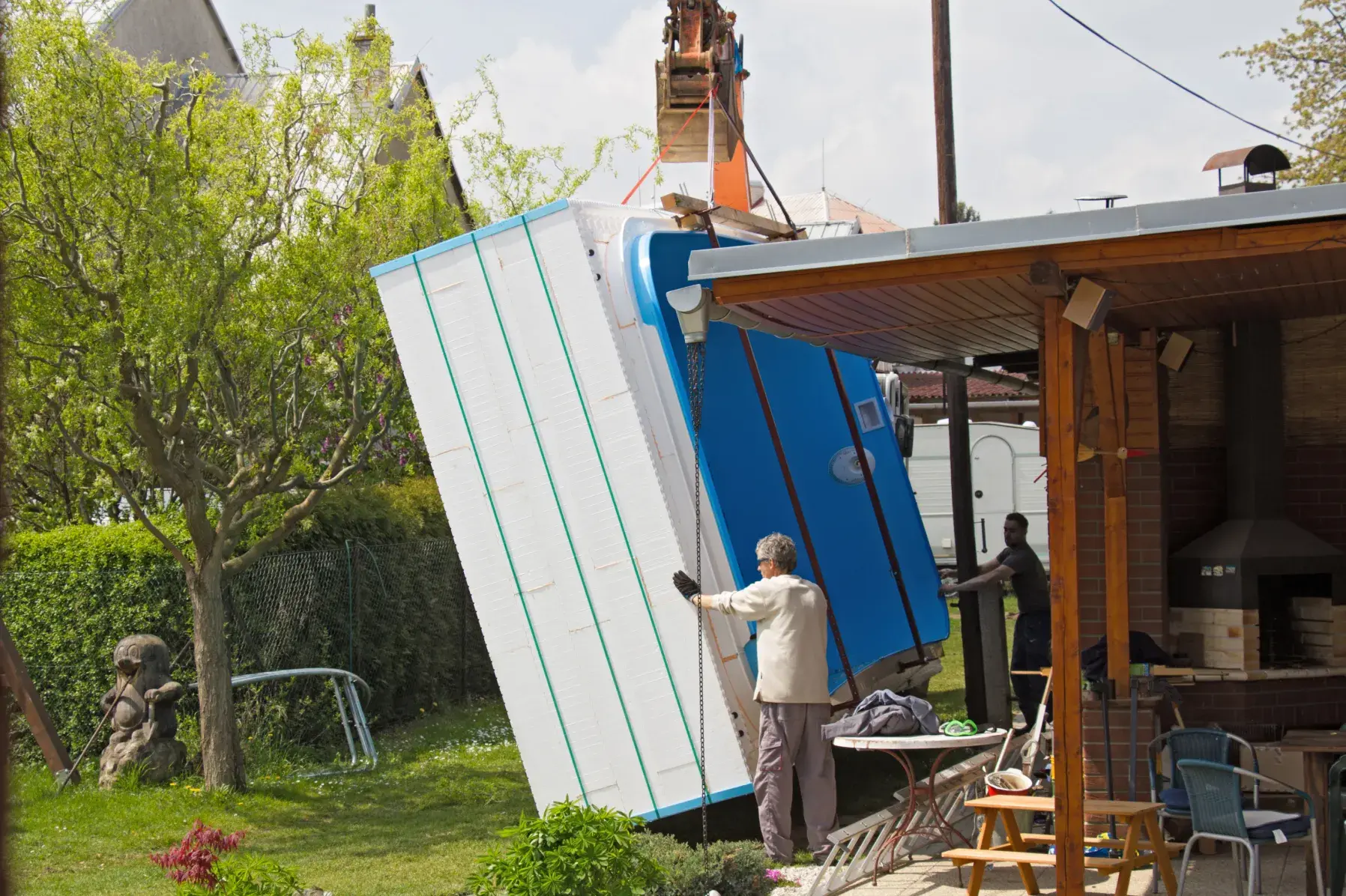
Can a fibreglass pool be craned over a house?
Yes. Fibreglass pools are craned over houses all the time.
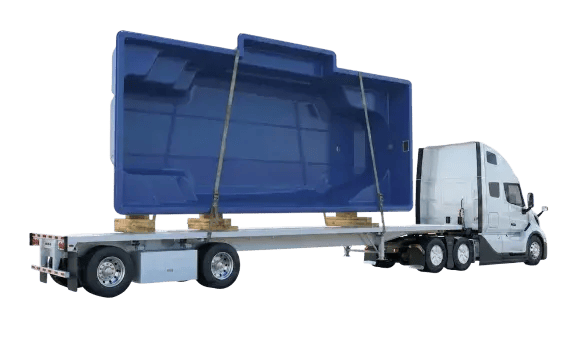
On tighter suburban sites, a mobile crane will usually lift the shell from the delivery truck and lower it into position over the house.
It can look fairly dramatic from the driveway, but for an experienced crane crew it’s all in a day’s work.
The required crane depends mainly on:
-
The weight and dimensions of the pool shell
-
The distance from the crane to the excavation
-
The available crane setup area
-
Obstacles along the lift path
A longer lift will usually require a larger crane. However, needing a crane is normal for many metropolitan installations and is not, by itself, a sign of a particularly difficult site.
On open rural properties, a pick-and-carry crane, often called a Franna, can move the shell closer to the excavation before lowering it into place.
Crane access for pool installation: Powerlines, trees and overhead clearance
Powerlines, tall trees, rooflines and neighbouring buildings can affect where the crane stands, how far it must reach and whether extra planning or safety controls are required.
Powerlines need the most care. The crane company must assess the lift against the electrical safety requirements that apply to the property and the relevant state or territory. Australian safety guidance requires risks from operating cranes and mobile plant near overhead electrical lines to be assessed and controlled.
Depending on the site, the crane company may change its setup position, choose different equipment, alter the lift path or arrange additional electrical safety controls.
Seeing a powerline does not mean you will definitely need electricity network involvement, but it should never be guessed around.
Trees, eaves, pergolas and second-storey overhangs can also affect the lift path. The answer may be a minor tree trim, a different crane position or a larger crane with enough reach to clear the obstacle safely.
Can the crane company assess the site remotely?
Often, yes.
Many crane companies can complete an initial assessment using your measurements, photos, Google Street View and aerial imagery.
An onsite assessment may be needed when:
-
The crane setup area is tight
-
The lift distance is unusually long
-
Powerlines or trees are close to the likely lift path
-
The property slopes significantly
-
Neighbouring structures limit the available space
-
The photos and measurements do not show the full site clearly
The crane company decides whether the information provided is enough or whether someone needs to inspect the property.
How narrow-access pool installation affects cost
Restricted access usually costs more because the work takes longer or requires different equipment.
| Access issue | Why it can cost more |
| Smaller excavation equipment |
Smaller machines remove less soil per trip, so the excavation takes longer. |
| Manual excavation |
More labour is needed to dig and move soil by hand. |
| Longer soil-removal route |
More machine time is required to carry soil from the backyard to the truck. |
| Fence, gate or landscaping removal |
Temporary removal and reinstatement may need to be included in the quote. |
| Longer crane reach |
A larger crane may be required to lift the shell safely into position. |
| Limited street setup |
Traffic management, permits or additional planning may be required. |
| Trees or powerlines near the lift path |
A different crane setup or additional safety controls may be needed. |
| Soft or sloping ground |
Ground protection, site preparation or different equipment may be required. |
One advantage of fibreglass is that the empty pool shell is relatively lightweight. The 6m Daintree fibreglass pool shell has a listed dry weight of 600 kg. By comparison, one Australian 6m by 3m precast concrete pool has a listed dry weight of 12,700kg. The large difference in weight hugely affects the crane size and lifting cost, particularly when the pool needs to be lifted over a house.
There is no reliable flat surcharge for difficult access. Two properties with the same side-access width can have very different costs once the lift distance, soil conditions, slope and truck position are considered.
Ask each trade to clearly explain what access conditions and equipment they have allowed for in the quote. Otherwise, the cheapest quote can become the most expensive one before the excavator has finished its first lap of the backyard.

Does a concrete pool solve an access problem?
Only if the problem is getting a one-piece fibreglass shell into the backyard.
For pools of a similar size and position, fibreglass and concrete projects require essentially the same excavation and soil-removal process. If restricted access calls for smaller machinery or manual digging, changing to concrete will not avoid that work or cost.
The main difference is that a fibreglass pool shell must be lifted into place, while a concrete pool is constructed onsite.
If a crane company confirms that a fibreglass shell genuinely cannot reach the proposed pool position, a concrete pool may be a practical alternative.
Concrete pools are generally more expensive overall, even after allowing for the crane used to install a fibreglass pool. Excavation access alone is therefore not a strong reason to choose concrete.
Compare the total project cost, design requirements and installation method before deciding.
When to arrange an installer, excavator or crane assessment
A basic self-assessment helps you ask better questions, but the trade carrying out the work must confirm the final method.
Contact an excavator or installer when you need confirmation of:
-
The machinery that can safely reach the backyard
-
How the excavated soil will be removed
-
Whether fences, retaining walls or services need protection or removal
-
The excavation method and equipment included in the quote
Contact a crane company when you need confirmation of:
-
The crane setup area and required reach
-
The lift path over the house
-
Powerlines, trees or nearby structures
-
Road, verge or neighbouring-property access
Assess your access before you order
Restricted access rarely rules out a pool, but it can change the machinery, labour, crane setup and installation cost.
Completing a basic site access assessment before requesting quotes helps trades understand the property and reduces the risk of surprises once work begins.
Complete Fibreglass Pool Kits supplies fibreglass pool shells and complete DIY pool kits across Australia. Send us your site photos, measurements and proposed pool position, and we can provide general guidance and point you towards the right trade where specialist advice is needed.
We do not conduct site visits or approve excavation or crane plans. Final equipment, access and safety decisions remain with the trade carrying out the work.
Frequently Asked Questions
Can a crane or excavator access my pool site through a neighbour’s property? Possibly, but you will need the neighbour’s permission and the contractor must agree that the route is safe and practical.
Confirm who is responsible for ground damage, fence removal, reinstatement and insurance before booking the work. Do not assume access across a neighbouring property will still be available on installation day.
What happens if site access changes after I receive a quote? Tell the relevant trade as soon as possible.
New fencing, landscaping, scaffolding, parked vehicles, wet ground or building work can change the equipment and access method allowed for in the quote. The contractor may need updated photos, a revised assessment or an adjusted price before work begins.
Can wet weather stop excavation or a crane lift? Yes. Heavy rain can soften the access route or crane setup area, making it unsafe for machinery or crane outriggers.
Ground protection may help on some sites, while others need time to dry before work can continue. The excavator or crane operator makes the final safety decision based on the conditions onsite.
Do I need approval if the crane or truck uses the street? You may need council approval, parking arrangements or traffic management if a crane, delivery truck or soil-removal truck occupies the road or verge.
Requirements vary by location. The crane company or excavator should identify what is needed, but ask early so permits or traffic controls do not delay the installation.


