.svg)








 Affordable Financing
 Below Ground Range Colours
 Fibreglass Pool Install Stages
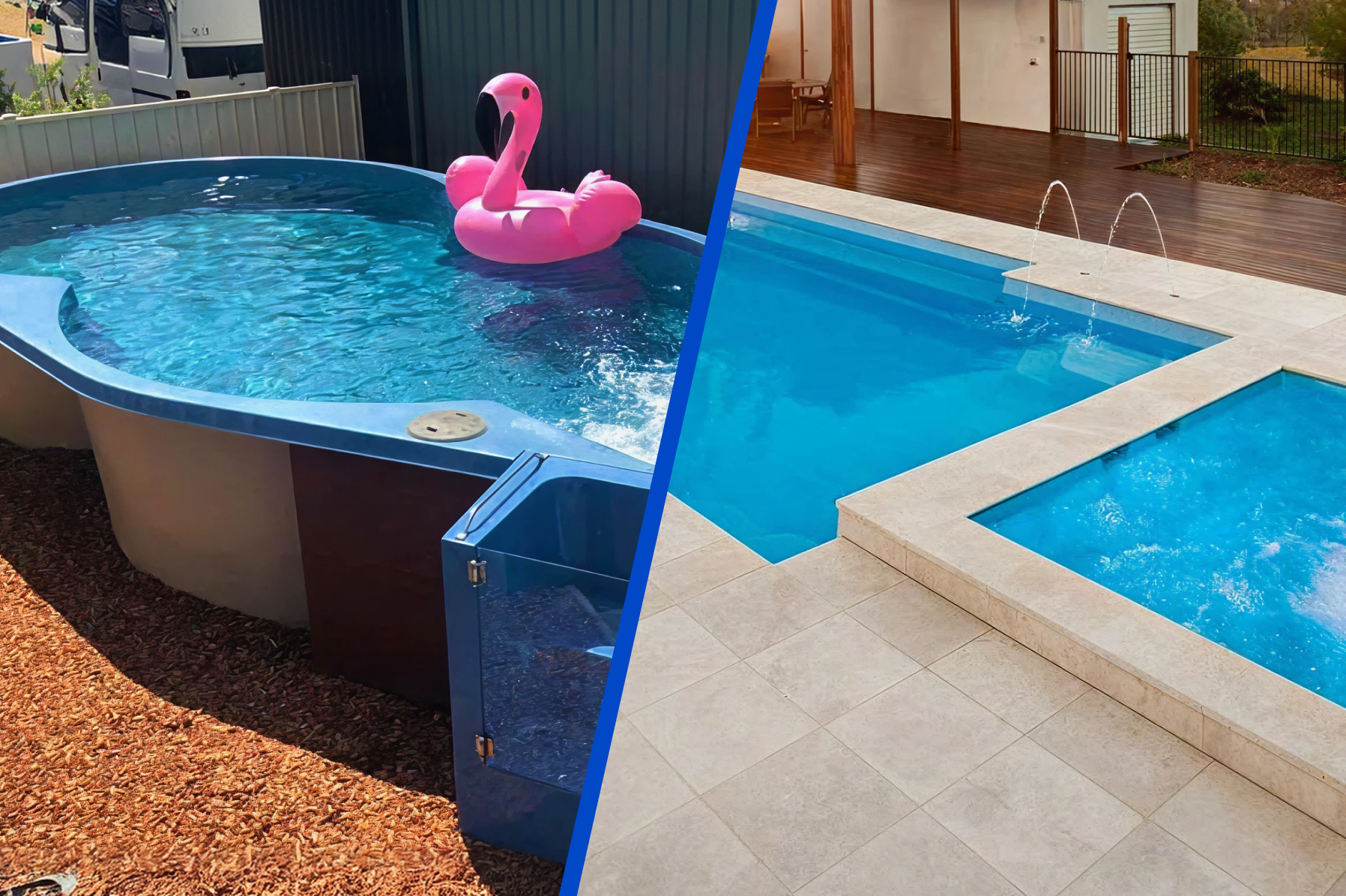
When most people picture a fibreglass pool, they picture it sunk into the ground with paving around it. But a fibreglass pool specifically designed and engineered for freestanding use can sit partly or fully above ground, and on the right block that makes a lot of sense. Above-ground fibreglass is a slightly different conversation to the in-ground comparison in our Fibreglass vs Concrete vs Vinyl Pools guide, but the same trade-offs apply, with cost and access doing most of the deciding.
Whether you DIY it or use a licensed installer, the configuration choice is the same. Above-ground and semi-in-ground just shift where the money and the effort go.
|
Quick Answer In-ground fibreglass integrates cleanly with the backyard and tends to add the most resale value, but the full excavation, backfill and concrete bond beam can push up the project cost. A purpose-built above-ground fibreglass shell generally costs more than a comparable standard in-ground shell because it requires additional materials, reinforcement and engineering to support the weight of the water without surrounding backfill. That higher shell cost is offset by the easier and generally lower-cost installation. Above-ground installation can reduce or eliminate deep excavation, cement-stabilised backfill and the concrete bond beam, making it particularly cost-effective on sloping, rocky or difficult-to-excavate blocks. It isn't automatically cheaper on every site, because you may still spend on base preparation, decking, cladding and a compliant pool barrier. Semi-in-ground, or partial burial, is the middle option and suits sloping blocks especially well. Our range includes purpose-built freestanding above-ground models alongside our standard in-ground shells. |
The Three Configurations
A fibreglass pool can sit in three different relationships to ground level:
-
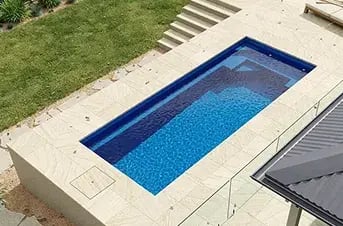
In-ground (fully buried). The pool sits entirely below ground, coping at or just above ground level. The standard look, and what most photos show.
-
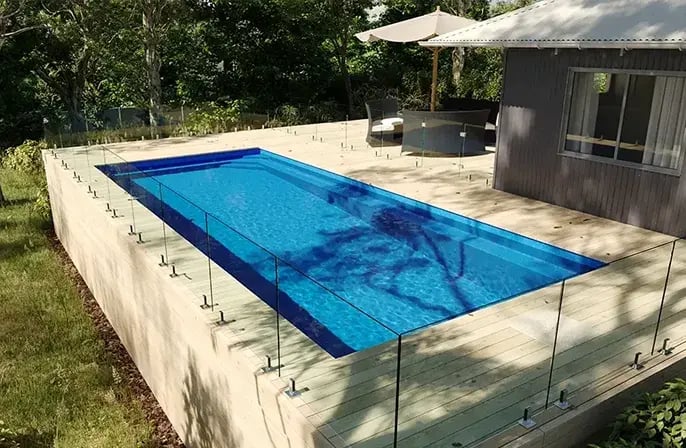
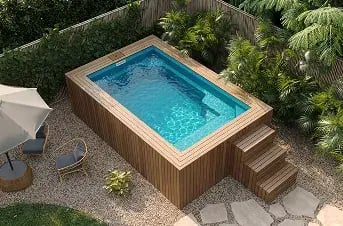
Above-ground. The pool sits above ground level and must use a shell specifically designed and engineered for freestanding installation. It uses its own engineered structural system and can be finished with decking or cladding around the exposed exterior.
-
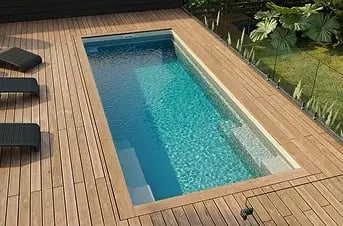
Semi-in-ground (partial burial). Buried partway, with the amount above ground determined by the site levels, soil conditions and engineering. Most common on sloping blocks where the ground level changes across the footprint.
Not every fibreglass shell is suitable for all three configurations. A standard in-ground shell relies on the surrounding backfill for support and should not simply be placed above ground and dressed up with decking.
CFPK’s freestanding above-ground fibreglass range is purpose-built for freestanding, semi-recessed or fully in-ground installation in accordance with the supplied engineering.
What Drives the Cost Difference
A quick word on how the pricing works: the kit prices shown on our website do not include delivery. We quote every delivery individually based on your location, and you pay what we pay without any markup. Your total also shifts with any changes or add-ons you make to the kit.
As a rough 2026 guide for the whole project, a full-service, fully installed in-ground fibreglass pool runs around $35,000 to $50,000 for a small (approximately 4.5m) build, $45,000 to $60,000 for a mid-size (approximately 7m) pool, and $60,000 to $85,000-plus for a large (approximately 10m) one.
These figures assume a straightforward site and broadly comparable basic inclusions. In an owner-builder or hybrid project, costs such as excavation, plumbing, electrical work, fencing and concreting are paid directly to the relevant trades rather than being included within a full-service builder price.
The full breakdown is in our Complete Fibreglass Pool Cost Guide.
The shell price of a purpose-built above-ground fibreglass pool will generally be higher than the price of a standard in-ground shell. The difference is that the above-ground shell can substantially reduce the work and cost required to install it.
A purpose-built above-ground pool can reduce or eliminate some of the most expensive in-ground site items, including deep excavation, cement-stabilised backfill and the concrete bond beam. What you add back is the extra engineering and reinforcement within the freestanding shell, along with any base preparation, decking, cladding, stairs or access platforms required to finish the area.
Semi-in-ground often lands somewhere between the two, since it still needs some excavation and may require backfill, drainage or retaining. It isn't a guaranteed middle price, though. On a difficult slope, the retaining and surrounding works can cost more than the excavation saving.
Why Pool Weight Matters
Weight makes a major difference to delivery and crane costs, particularly when comparing freestanding fibreglass with precast concrete.
A precast concrete pool can weigh up to 10,000kg. That makes it expensive to deliver and very expensive to lift into place, with the crane alone potentially costing up to $15,000 on a difficult site.
Precast concrete pools are also flat-bottomed and generally shallow, which limits the size and swimming depth available.
By comparison, an 8m CFPK freestanding fibreglass pool weighs approximately 2,000kg. Depending on location and access, delivery and crane placement will generally cost around $1,500 to $3,000.
The CFPK range includes full-size pools with greater width and depth than most precast concrete options. Models are also available with a shallow end and deep end, so you aren't limited to a small, flat-bottomed plunge pool simply because the pool sits above ground.
A few line items don't change much with configuration. You still need to place the shell, run plumbing and electrical work, obtain the required approvals and provide a compliant pool barrier. It's the shell cost, earthworks, structural work, delivery and cranage that move.
|
Configuration |
Relative upfront cost |
Best suited to |
|
In-ground |
Lower standard shell cost, but often higher total installation cost because of full excavation, backfill and the bond beam |
Flat, accessible blocks; the standard integrated look |
|
Semi-in-ground |
Varies with excavation, retaining, drainage and finishing requirements |
Sloping blocks where ground level changes across the footprint |
|
Above-ground |
Higher shell cost, offset by easier installation and reduced excavation, backfill and concrete work |
Sloping or rocky blocks, difficult excavation and faster builds |
Above-ground earns its keep where going in-ground would hurt, such as Sydney sandstone, rocky ground or a steep block, because that's exactly where excavation and retaining costs spike.
Reactive clay still requires proper site preparation, drainage and compliance with the supplied engineering. Above-ground installation doesn't make ground conditions irrelevant.
It's also a strong DIY option for the same reason: less earthworks can mean less heavy machinery and fewer trade days.
If you're weighing the whole-of-life numbers, our Pool Lifetime Cost Comparison: Which Pool Offers the Best Value Over 20 Years? runs them, and customisation options covers how the finish and surrounds pull an above-ground pool together.
Longevity and Resale
An above-ground fibreglass shell designed and engineered for freestanding use can last just as long as an in-ground shell when it is installed correctly.
CFPK's standard in-ground shells and freestanding above-ground range are backed by a 35-year structural warranty. The warranty applies when the pool is installed in an approved configuration and in accordance with the supplied engineering, installation requirements and warranty conditions.
The structural warranty applies to the shell itself. The cosmetic gelcoat warranty is separate and should not be confused with the structural life of the pool.
What differs is the work surrounding the shell. Timber decking, cladding, access platforms, retaining walls and drainage systems have their own maintenance requirements and useful lives.
On resale, a well-integrated in-ground pool generally reads as the “premium” option to buyers, but a tidy above-ground or semi-in-ground pool with good decking or cladding presents well too, especially on a block where in-ground was never realistic.
Fencing Applies Either Way
Configuration doesn't remove your safety obligations. Above-ground, semi-in-ground and in-ground pools are all subject to state and territory pool-barrier laws that draw on AS 1926.1.
The barrier may be separate fencing or, for an approved pool design, an integrated barrier system that meets the requirements applying in your location. Do not assume that simply raising the pool means no fence or barrier is required.
Any raised deck, stairs, platform or step that gives access to the pool has to be factored into the barrier design. Check the design with your certifier before building the surrounding deck or access structure.
Which Configuration Suits Your Block?
If your block is flat and the flush, integrated look matters most, in-ground usually wins. If slope, rock or excavation and retaining costs are blowing up the budget, a purpose-built freestanding or semi-recessed model may be the smarter option.
Talk to the team at Complete Fibreglass Pool Kits about your block, access, site levels and the finish you want. We'll help you compare the real shell, delivery, cranage, site-work and surround costs so you're not choosing based on an excavation saving that disappears into the decking later.

Frequently Asked Questions
Are above-ground fibreglass pools cheaper than in-ground? The above-ground shell will generally cost more than a comparable standard in-ground shell because it requires additional materials, reinforcement and engineering.
That higher shell cost can be offset by a simpler and lower-cost installation, particularly where the pool avoids expensive excavation, cement-stabilised backfill, retaining or bond-beam work. The final answer depends on the block, access and how you finish the area around the pool.
Can a fibreglass shell be installed above ground? Yes, but only if the shell has been specifically designed and approved for freestanding or partially raised installation. A standard in-ground shell relies on surrounding backfill for support and should not simply be placed above ground. CFPK offers a dedicated freestanding range for above-ground, semi-recessed and fully in-ground installations.
How does a fibreglass above-ground pool compare with precast concrete? A precast concrete pool can weigh up to 10,000kg, making it expensive to deliver and crane into place. The crane alone can cost up to $15,000 on a difficult site.
An 8m CFPK freestanding fibreglass pool weighs approximately 2,000kg, with delivery and crane placement generally costing around $1,500 to $3,000, depending on location and access.
Precast concrete pools are also flat-bottomed and generally shallow. The CFPK range includes full-size pools with greater width and depth, including models with a shallow end and deep end.
Do above-ground fibreglass pools last as long as in-ground? A purpose-built above-ground shell can last just as long as an in-ground shell when it is installed in accordance with its engineering and warranty conditions. CFPK's standard in-ground shells and freestanding range carry a 35-year structural warranty. Decking, cladding, retaining and other surrounding structures have their own maintenance requirements and useful lives.
What's a semi-in-ground pool? A pool buried partway, with the amount above ground determined by the slope, soil conditions, drainage and engineering. It's common on sloping blocks where the ground level changes across the pool footprint.
Do above-ground pools need a fence? They need a compliant pool barrier. Depending on the approved design and the requirements in your state or territory, that may be separate fencing or an integrated barrier system. Any deck, stairs, platform or step giving access to the pool has to be included in the barrier design.


