.svg)









 Affordable Financing
 Fibreglass Pool Install Stages
How much does a fibreglass pool actually cost in Australia?
The practical answer starts with “it depends”, but that is not much help when you are trying to work out whether your backyard dream is a $45,000 project, a $95,000 project, or something in between.
So let’s give you the real 2026 numbers first.
In Australia, a fibreglass pool kit usually costs around $20,000–$40,000, depending on the shell size and equipment package. A simple hybrid kit plus installer pathway may start around $40,000–$60,000 all-in, while broader hybrid projects with more installer scope, fencing, paving or site work can land closer to $50,000–$80,000. A full-service fibreglass pool builder quote is more commonly $55,000–$110,000+.
Complete Fibreglass Pool Kits supplies the fibreglass pool shell, equipment package and practical guidance. We do not pretend the kit price is the finished backyard price, because excavation, fencing, approvals and surrounds still need to be allowed for.
The final number depends on your block, your council, your inclusions and how much of the project you want to coordinate yourself. A flat block with easy access is a very different job to a sloping backyard with rock, tight access and glass fencing. Same pool shape, very different invoice.
This guide breaks down the real cost ranges, what is usually included, what is usually excluded, and the hidden costs buyers often miss until the quote, the council paperwork or the excavation day lands in their lap.
Quick Answer: How much does a fibreglass pool cost in Australia?
In 2026, a fibreglass pool kit usually costs around $20,000–$40,000, depending on shell size and equipment inclusions.
A hybrid installation, where you buy the pool kit and use a licensed installer or chosen trades for the on-site work, can start around $40,000–$60,000 for simpler projects. Broader hybrid installations commonly land closer to $50,000–$80,000 all-in, depending on site conditions, installer scope, fencing, paving and finishes.
A full-service fibreglass pool builder quote is more commonly $55,000–$110,000+ for an equivalent build.
DIY and hybrid pathways can save money by reducing or removing the full-service builder margin and, in some cases, reducing labour costs if you can legally complete parts of the work yourself. Excavation, crane access, plumbing, electrical, bond beam, backfill, fencing, paving, approvals and certification still need to be paid for. The saving comes from how directly you manage them, not from pretending they disappear.
All pricing in this guide is indicative only and varies by state, site access, engineering requirements, inclusions, and market conditions.
engineering requirements, inclusions, and market conditions.

Fibreglass Pool Cost Australia: 2026 Price Ranges at a Glance
Let’s get the headline numbers out of the way first.
Treat these as planning allowances, not fixed quotes. Every site is different, and the rest of this guide explains why.
DIY fibreglass pool kit
A DIY pool kit usually includes the fibreglass pool shell and standard equipment package. The homeowner then organises the site-specific work separately.
Typical range:
|
Pool type |
Typical kit range |
|
Plunge pool, under 5m |
$20,000–$26,000 |
|
Small family pool, 6–7m |
$21,000–$27,000 |
|
Standard family pool, 7–9m |
$23,000–$29,000 |
|
Large or lap pool, 9m+ |
$26,000–$32,000 |
A kit price is not the finished pool price. It does not include excavation, crane hire, plumbing labour, electrical work, fencing, paving, landscaping, approvals or certification.
This is where many buyers get caught. The kit might be clear, fair and well priced, but the backyard still needs to be dug, fenced, certified and finished. Boring? Maybe. Important? Absolutely.
Hybrid pool installation
A hybrid pathway means you buy the pool kit separately, then engage a licensed installer to complete some or all of the on-site work.
Typical all-in range:
|
Pool type |
Typical hybrid range |
|
Plunge pool |
$40,000–$60,000 |
|
Small family pool |
$43,000–$63,000 |
|
Standard family pool |
$45,000–$65,000 |
|
Large or complex pool |
$49,000–$80,000+ |
This pathway suits homeowners who want more control than a full-service pool builder quote, but do not want to manage every trade on their own.
Full-service fibreglass pool builder quote
A full-service pool builder usually supplies the pool, manages the installation, coordinates trades and includes project management, business overheads and builder margin in the quote.
Typical range:
|
Pool type |
Typical full-service builder range |
|
Plunge pool |
$55,000–$75,000 |
|
Small family pool |
$65,000–$85,000 |
|
Standard family pool |
$70,000–$90,000 |
|
Large or premium pool |
$75,000–$110,000+ |
A full-service quote can be the right choice if you want one company coordinating most of the project. The trade-off is that you pay for that coordination, convenience and accountability.
Premium backyard transformations can push higher again, especially where the project includes large-format paving, glass fencing, automation, retaining walls, large-area landscaping, outdoor kitchens or difficult crane access.
Before You Compare Prices, Know Which Type of Quote You Have
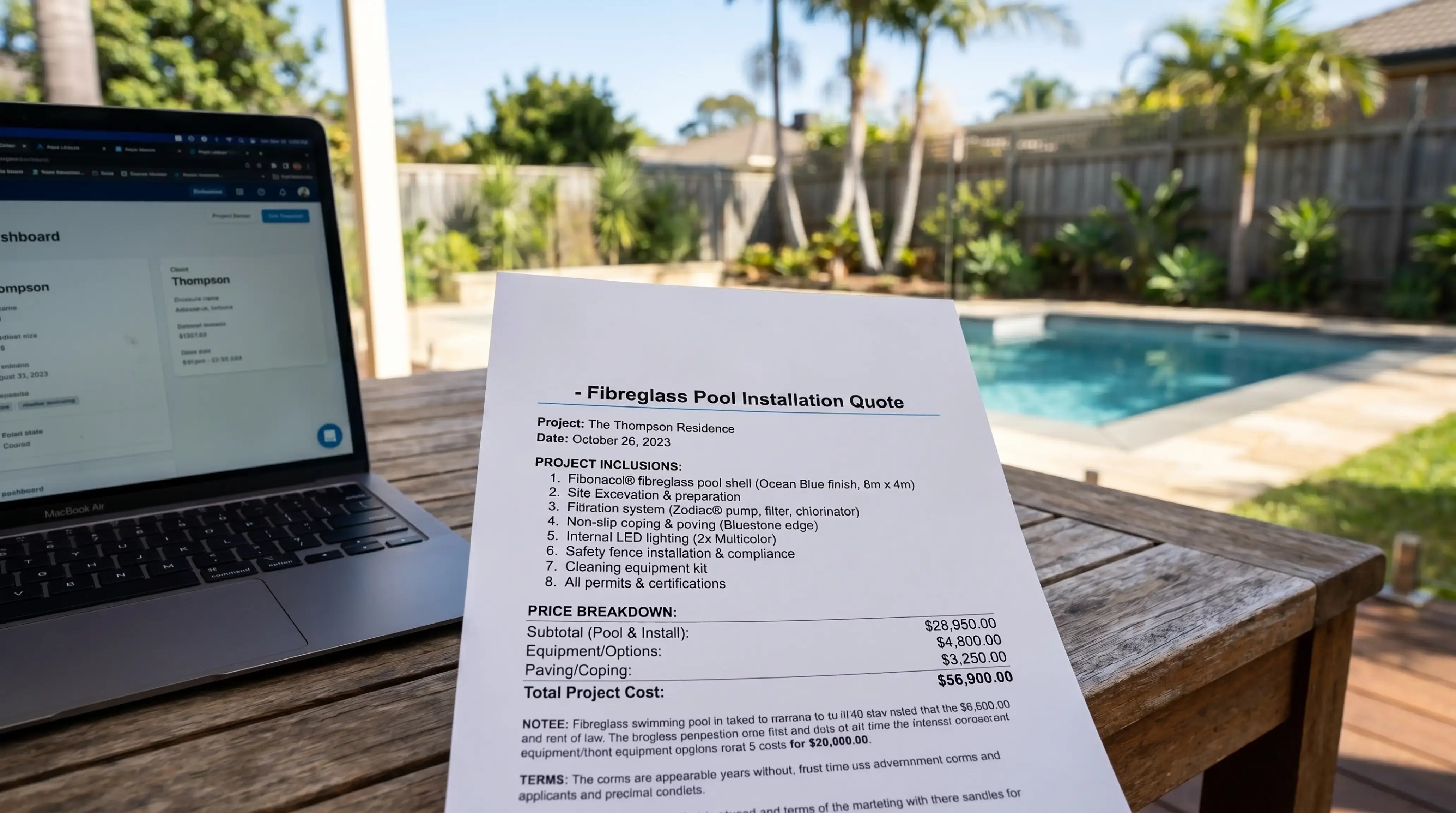
A “fibreglass pool quote” can mean three completely different things.
One quote might only include the pool shell and equipment. Another might include the shell, installation, approvals, fencing, paving and project management. A third might sit somewhere in the middle.
That is why the cheapest quote is not always the cheapest finished pool. Sometimes it is just the quote with the most expensive bits left out.
DIY pool kit quote
A DIY fibreglass pool kit quote usually covers the pool shell and equipment only.
The homeowner then organises the on-site costs separately, such as:
- excavation
- crane access
- plumbing labour
- electrical work
- concrete bond beam, the reinforced concrete support around the top edge of the pool
- backfill, the material placed around the shell to lock it into position
- paving
- fencing
- council approvals
- certification
This pathway gives you the most control and cost savings, but also the most responsibility.
Hybrid pool quote
A hybrid quote sits between DIY and full-service.
You buy the pool kit separately, then engage a licensed installer or chosen trades to handle some or all of the installation.
This can work well for homeowners who want professional help with the technical parts, but still want to avoid paying a full-service builder to manage every moving piece.
Full-service pool builder quote
A full-service fibreglass pool builder quote is broader.
It usually includes the pool shell, equipment, installation trades, project management, approvals and builder margin. Depending on the scope, it may also include fencing, paving, coping, landscaping and warranty coordination.
This is often the simplest pathway for the homeowner, but it is usually the most expensive because you are paying for coordination, project management, business overheads and builder margin.
If you want a checklist of what should be in a fibreglass pool quote — and what each quote type usually leaves out — we've broken it down line by line.

What Drives the Final Number on a Fibreglass Pool Quote?
If two quotes for “the same pool” come back $30,000 apart, it does not always mean one builder is ripping you off and another is your new backyard hero.
In most cases, it means the quotes are covering different things.
We unpack why pool prices vary between installers — and the red flags worth watching — in more detail, but here's the short version.
One quote may include fencing, approvals and paving. Another may only include the shell, equipment and basic installation. On paper, they both say “fibreglass pool”. In real life, they are not the same backyard.
The five biggest cost drivers are:
1. Pool size and shape
A 4m plunge pool is cheaper than an 8m family pool.
That sounds obvious, but the difference is not just the shell. A larger pool also usually means:
- more excavation
- more soil removal
- more backfill
- more concrete
- more plumbing
- more coping and paving
- more fencing and surrounds
- higher running costs
Simple shapes are also generally easier to install than highly customised designs.
Always check if the dimensions include the coping beam, which is the flat lip around the top of all fibreglass pools. If the coping beam is 200mm wide, an 8m x 4m pool actually has a swimming area of 7.6m x 3.6m. Measurements of the actual swimming area are called waterline measurements, and they tell you how much swimming area you are actually getting.
2. Shell quality and warranty
Not all fibreglass pool shells are the same.
Look at:
- the structural warranty
- the gelcoat or surface warranty
- the manufacturing process
- whether the shell is Australian-made
- who handles warranty support
- what can void the warranty
A cheaper shell may reduce the upfront price, but it can also come with shorter warranty terms or lower-quality surface finishes.
Complete Fibreglass Pool Kits supplies Australian-made fibreglass pool shells with a 35-year structural warranty and AquaGuard-X™ gelcoat finish.
3. Equipment inclusions
Two quotes might both say “filtration included”, but that does not mean they include the same equipment.
Check whether the quote includes:
- pump type and brand
- whether it is Australian-made or imported
- filter type and size
- salt chlorinator
- pool lights
- skimmer box
- return jets
- cleaner
- pool cover
- heating
- automation
A higher-quality equipment package can add cost upfront, but it may also reduce running costs and replacement issues later.
4. Site and access
Your block can change the price quickly.
A flat block with clear access is easier and cheaper to work with. A sloping block, tight side access, rock, groundwater, retaining walls or crane challenges can all add cost.
Access problems alone can add $2,000–$10,000 to a project. In difficult inner-suburban jobs, especially where traffic management or large crane reach is needed, surprises can reach around $15,000.
5. Surrounds and finishing
The pool shell is only one part of the backyard.
Paving, fencing, decking, retaining, drainage and landscaping can add a large amount to the finished project.
A pool with basic concrete surrounds is a very different project from a finished outdoor living area with travertine paving, glass fencing, lighting, heating and landscaping.
The Cost Breakdown: Where Every Dollar Actually Goes
Buyers often imagine the shell is the bulk of the cost.
It usually is not, once the full backyard is included.
Here is a typical breakdown for an all-in family pool project using a full-service pool builder in Australia in 2026.
|
Line item |
Approximate share |
Lower range |
Upper range |
|
Pool shell and standard equipment |
47–56% |
$35,000 |
$42,000 |
|
Excavation and earthworks |
4–8% |
$3,000 |
$6,000 |
|
Crane and delivery |
4–8% |
$3,000 |
$6,000 |
|
Plumbing and electrical labour |
1–2% |
$900 |
$1,500 |
|
Concrete bond beam and backfill |
3–7% |
$2,000 |
$5,000 |
|
Pool fence |
4–9% |
$3,000 |
$7,000 |
|
Surrounds, paving, decking or basic landscaping |
7–20% |
$5,000 |
$15,000 |
|
Council fees and certification |
1–3% |
$800 |
$2,000 |
|
Subtotal before builder margin |
|
$52,700 |
$84,500 |
|
Full-service builder margin and project management, 20% |
20% |
$10,540 |
$16,900 |
|
Estimated total including 20% builder margin |
|
$63,240 |
$101,400 |
The trade lines vary by site, soil, access and material choices. This is also where many cheap-looking quotes fall short. The shell may be priced clearly, but the real movement often sits in excavation, crane access, fencing, surrounds and site-specific labour.
Travertine over plain concrete can add thousands. Frameless glass fencing over black aluminium can add thousands more. Heating, automation and premium landscaping can shift the total again.
This is why a “$29,990 fibreglass pool” ad is rarely the finished backyard price. That figure is usually for the shell, or shell plus some equipment. It does not usually include the bits that touch dirt, concrete, council, fencing or certification.
Nobody wants to discover the “cheap” quote forgot the part where the pool actually needs to get into the ground.
Cheap fibreglass pool quote red flags
Be careful if a quote:
-
does not clearly state whether it is kit-only, hybrid or full-service
-
leaves out excavation, crane access, fencing, approvals or certification
-
uses vague words like “standard install” without explaining what that means
-
does not list equipment brands or model types
-
has no clear rock, access or variation policy
-
does not explain who manages council paperwork
-
makes the finished pool price look much lower than every other quote
- A cheap quote is not automatically bad. But a vague quote is risky.
DIY vs Hybrid vs Full-Service: How Much Can You Save?
DIY vs Hybrid vs Full-Service at a Glance
|
Pathway |
Typical cost range |
Best for |
Main trade-off |
|
DIY pool kit |
$20,000–$40,000 for the kit |
Hands-on owners who can coordinate trades or complete some work themselves |
Most responsibility |
|
Hybrid installation |
$40,000–$80,000 all-in |
Owners who want savings but still want installer or trade support |
Some coordination still required |
|
Full-service pool builder |
$55,000–$110,000+ |
Owners who want one company managing most of the project |
Usually higher cost |
This is where Complete Fibreglass Pool Kits is different from many pool companies.
We supply the fibreglass pool kit and expert guidance, then you choose how much of the project you want to manage or do yourself.
DIY pathway
A motivated DIY buyer can often save $10,000–$25,000 compared with a full-service pool builder quote for a similar project.
Where you sit in that range depends on how hands-on you are.
At the lower end, the saving usually comes from coordination. You source quotes, book trades directly, manage the sequence and reduce the full-service builder’s project management margin. The trade labour still exists, you are just paying for it more directly.
At the higher end, the saving comes from reducing labour costs. For example, if you can legally do the excavation yourself, help place the pool and manage the backfill, you may remove a significant amount of paid labour from the project.
The materials still need to be paid for, and licensed work still needs to be handled by the right licensed trades. Electrical work and equipotential bonding, the safety connection used to reduce shock risk around pools, must be completed by a licensed electrician. But you are not paying someone else to do every hands-on task.
As a guide:
- Mostly coordinating trades: potential saving around $10,000–$15,000
- Hands-on owner with machinery access or trade support: potential saving around $15,000–$25,000
You do not need to be a superhero with a shovel. But you do need to be organised, realistic and willing to bring in licensed trades where required.
DIY can save real money, but only if the work is planned properly and you are honest about your skills, time and site conditions.
Hybrid pathway
A hybrid installation is often the middle ground for homeowners who want savings, but not the full DIY workload.
You buy the pool kit, then use a licensed installer or chosen trades to complete some or all of the on-site work.
This pathway can often save around $5,000–$20,000 compared with a full-service pool builder quote for a similar project.
At the lower end, you may still pay trades or an installer to handle most of the hands-on work, while you coordinate parts of the job yourself.
At the higher end, you might take on more practical work, use trusted trades you already know, organise excavation, help with backfill, or manage paving and landscaping separately.
Excavation, crane access, plumbing, electrical, backfill, fencing and certification all still need to be paid for. The savings come from having more control over who does the work, what gets included and how the project is managed.
Full-service pool builder pathway
A full-service pool builder manages most or all of the project for you.
You usually pay more, but you also get:
- one company coordinating the job
- less trade management on your side
- project scheduling handled for you
- a clearer single point of contact
- more convenience if the site is complex
This can be the best option if you are time-poor, nervous about managing trades, or dealing with a difficult site.
Just make sure the quote clearly explains what is included, what is excluded, which items are allowances and what happens if your site throws a curveball.
Not sure which pathway suits your block, budget and confidence level? Complete Fibreglass Pool Kits can help you understand what is included in the kit, what sits outside it, and what you may need to allow for before you start digging.
Site and Block Costs Most Buyers Do Not See Coming
The hidden line in most fibreglass pool budgets is not the shell. It is what your block decides to reveal on excavation day.
We've mapped these out in detail in our hidden costs of pool ownership in Australia guide.
Most of these costs are not truly hidden. They are variable, which is different. They depend on your soil, access, slope and underground services.
Rock, slope and tight access are the backyard party crashers. You do not always know they are coming, but when they arrive, they bring invoices.
How much contingency should you allow?
As a planning rule, allow a contingency of around 10–15% for a fibreglass pool project, especially if your site has slope, tight access, older services, uncertain soil or possible rock.
That does not mean you will spend it. It means one surprise does not derail the whole project.
A simple, flat, easy-access block may need less. A sloping or tight-access block should have more breathing room in the budget.
Rock
Rock can add $2,500–$10,000 to an excavation, depending on volume and hardness.
Sydney sandstone, Brisbane ironstone, Melbourne basalt pockets and rocky Adelaide sites can all create extra excavation costs.
A geotechnical soil report can cost around $600–$900, but it can reduce the risk of nasty surprises.
Slope and retaining
A block that drops across the pool footprint may need retaining walls or additional engineering.
Depending on the height and length of retaining required, allow around $3,000–$20,000.
The more slope you have, the more important it is to get proper site advice before locking in the pool position.
Underground services
Sewer, stormwater, gas, water, electrical mains and NBN can all affect where the pool can go.
A Before You Dig Australia check is essential before excavation because it helps identify underground infrastructure before machinery hits the backyard.
Minor service adjustments might cost a few thousand dollars. Re-routing a mains sewer line through a pool footprint can become a $10,000–$30,000 problem.
Nobody wants that surprise halfway through the backyard dream.
Soil disposal
A standard family pool can produce 50–80 cubic metres of spoil.
Soil disposal costs depend on how much soil leaves the site, travel time to the tip, truck access and local tipping fees.
Typical disposal costs can sit around $1,500–$5,000, and contaminated soil can cost more.
Access
Tight side access can mean smaller machines, more labour and longer excavation time.
If the pool shell needs to be craned over a house, trees or powerlines, crane costs can increase.
Access issues often add $2,000–$10,000, with difficult inner-suburban projects sometimes reaching around $15,000 when larger cranes or traffic management are required.
The fix is simple: get a proper site inspection before you commit. That is not a scare tactic. It is just how pool budgets work.

Council, Compliance and Insurance: The Mandatory Add-Ons
You cannot skip council approvals, pool fencing or compliance.
These are not Complete Fibreglass Pool Kits rules. They are legal requirements.
Council approval and certification
Most pool installations need some form of approval, permit or certification.
Fees vary significantly between states, councils and certifiers, so always check your local requirements before committing.
As a broad planning allowance, allow around $800–$2,000 for council approval, certification and inspection-related costs.
Some projects may cost more, especially where site-specific engineering, additional inspections or private certification are required.
Pool fencing
All Australian pools need compliant safety barriers.
For a standard backyard, pool fencing often costs around $3,000–$7,000, depending on layout, material and access.
Frameless glass fencing can add $3,000–$8,000+ compared with simpler aluminium options.
Pool fence certification
Once the fence is installed, it must be inspected and certified by a registered pool safety inspector or relevant authority.
Certification fees usually range from $150–$350, although this varies by state and council.
Council rates
Installing an in-ground pool can increase your property’s capital value, which may affect council rates.
As a practical planning allowance, council rates may increase by around $200 per year, although the exact figure depends on your council, valuation method and revaluation cycle.
Home insurance
You should notify your insurer before installing a pool.
A pool can affect risk, legal liability settings and your premium.
As a planning allowance, home insurance often increases by around $30–$100+ per year, but you should confirm your own policy in writing.
We've covered state-by-state inspection rules and the figures to budget for in council rates and insurance: how much will they increase?
Running Costs: What Your Pool Actually Costs Each Year
The build price is the headline.
The running cost is the long tail.
It is not usually one scary bill. It is the steady drip of power, chemicals, water, servicing and the odd replacement part.
In 2026, most owner-maintained fibreglass pools cost around $1,200–$2,500 per year to run, excluding major equipment replacement.
That usually includes electricity, chemicals, water, cleaning supplies, minor maintenance and insurance increases.
Pool servicing can add $1,500–$3,000 per year if you outsource maintenance. Heating can add anywhere from $300–$2,500+ per year, depending on climate, heating type, pool cover use and how long you extend the season.
Typical annual running cost breakdown
|
Cost line |
Typical annual range |
|
Variable-speed pump electricity |
$200–$400 |
|
Single-speed pump electricity |
$900–$1,400 |
|
Chemicals |
$250–$500 |
|
Water top-ups |
$40–$120 |
|
Cleaning supplies and minor maintenance |
$100–$350 |
|
Insurance increase |
$30–$100+ |
|
Pool service, if outsourced |
$1,500–$3,000 |
|
Heating, if used |
$300–$2,500+ |
In practical terms, the difference between an efficient variable-speed pump and an older single-speed pump can be hundreds of dollars a year, especially if the pump runs long hours through summer.
The cheapest pools to run usually have:
- a variable-speed pump
- a pool cover
- efficient filtration settings
- daytime pump operation matched to solar power
- regular water testing
- sensible landscaping that keeps leaves and debris out of the pool
A variable-speed pump is one of the best long-term upgrades. It may cost more upfront than a single-speed pump, but the electricity savings can be significant over time.
For the full line-by-line breakdown of pool running costs per year in Australia, including state-by-state variations, see our running costs guide.
Long-Term Equipment Replacement Costs
Pool equipment does not last forever.
Over a 15-year period, most pool owners should expect to replace several major pieces of equipment.
As a realistic planning allowance, set aside around $20,000–$30,000 over 15 years for replacement equipment in today’s dollars, depending on the pool size, usage, heating, water chemistry, and maintenance.
Common replacement items include:
|
Equipment |
Typical replacement cost |
|
Single-speed pump |
$800–$1,000 |
|
Variable-speed pump |
$2,000–$2,500 |
|
Pool filter |
$700–$1,800 |
|
Salt chlorinator cell |
$700–$1,200 |
|
Salt chlorinator controller |
$1,200–$1,700 |
|
LED pool lights |
$300–$600 per light |
|
Heat pump or gas heater |
$3,500–$9,000 |
|
Robotic cleaner |
$1,200–$2,500 |
|
Manual pool blanket |
$600–$1,500 |
This is not a reason to avoid a pool.
It is a reason to budget properly from the start.
A pool is a long-term asset, and like any long-term asset, it has parts that wear out.
Heating: Cost vs Comfort vs Climate
The “should I heat my pool?” question is genuinely climate-dependent in Australia.
A Queensland pool can be comfortable for much of the year without heating. A Melbourne pool may only feel naturally comfortable for a shorter summer window.
For many homeowners, pool heating is worth it because it increases how often they use the pool.
In Australia, most pool owners spend around $200–$1,800 per year on pool heating, depending on climate, heating type, usage and whether they use a pool blanket.
A pool blanket can reduce heat loss dramatically, which makes it one of the most important additions to any heating setup.
Main pool heating options
|
Heating option |
Upfront cost |
Running cost |
Best for |
|
Heat pump |
$3,000–$8,000 |
Low to medium |
Most Australian households wanting efficient season extension |
|
Gas heater |
$4,000–$7,000 |
High |
Fast heating, spas and occasional rapid heat-up |
|
Solar heating |
$4,000–$8,000 |
Very low |
Sunny climates and low running costs |
|
Pool blanket |
$800–$1,500 |
Very low |
Reducing heat loss and cutting running costs |
Typical heat pump running costs with a pool blanket
For season extension, many owners using a heat pump and pool blanket see running costs closer to:
|
Climate example |
Typical annual range |
|
Brisbane |
$200–$400 |
|
Sydney |
$300–$500 |
|
Melbourne |
$400–$600 |
|
Perth |
$300–$500 |
|
Adelaide |
$400–$600 |
Costs can climb higher if you want year-round swimming, run the heater heavily, skip the pool blanket or live in a cooler climate.
For most families, the best-value heating setup is usually a heat pump plus a pool blanket. It will not heat as fast as gas, but it is usually much cheaper to run.
We crunched the numbers in detail at is a heated pool worth it in Australia?

Pool Finance: How Australians Pay for Their Pool
Many fibreglass pool buyers finance part of the project.
The way you pay for the pool can change the lifetime cost almost as much as the pool type itself.
This is general information only and does not take your personal financial circumstances, loan structure, tax position or borrowing capacity into account. Always speak with a licensed financial adviser, accountant or mortgage broker before making borrowing decisions.
Common pool finance options in Australia
|
Finance option |
Typical 2026 rate |
Best for |
|
Home loan top-up |
6.0–7% variable |
Homeowners with equity |
|
Redraw or offset |
Same as mortgage |
Owners ahead on repayments |
|
Personal loan |
7–14% |
Buyers without equity or wanting a separate loan |
|
Dedicated pool loan |
8.5–13% |
Buyers wanting pool-specific finance |
|
BNPL or store finance |
12–25%+ effective |
Usually worth checking very carefully |
For many homeowners, the lowest-rate option is a home loan top-up, redraw or offset.
The catch is loan term.
A pool added to a 30-year mortgage may look affordable week to week, but it can cost much more in total interest if you do not make extra repayments.
Personal loans and dedicated pool loans can be faster and simpler, but they usually cost more.
Before choosing finance, compare:
- comparison rate
- loan term
- setup fees
- monthly fees
- early repayment rules
- total interest payable
- whether the repayments still work if rates move
The cheapest-looking repayment is not always the cheapest loan.
We compare the five main pathways — home loan top-up, redraw, personal loan, dedicated pool loan and BNPL — in pool finance in Australia: loans vs redraw vs personal loans.
Best Time of Year to Buy a Pool in Australia
The best time to buy a swimming pool in Australia is usually autumn or winter if you want better value, more planning time and a smoother run into summer.
That does not mean every pool suddenly gets cheaper in winter.
Base pool kit prices, meaning the shell plus standard equipment package, generally stay fairly consistent year-round.
The seasonal value usually comes from:
- full-service pool builders being more open to sharper pricing in quieter months
- better trade availability
- more time to compare quotes properly
- supplier-led offers on added equipment or upgrades
- less pressure before the summer rush
Autumn and winter
Autumn and winter are often the smartest planning windows.
You are ahead of the spring rush, trades may have more breathing room, and full-service pool builders may be more flexible if they are filling winter calendars.
For kit buyers, the advantage is usually not a cheaper base kit. It is better planning time and possible supplier-led offers on equipment or upgrades.
Spring
Spring demand rises quickly.
By September and October, many buyers suddenly want to be swimming by Christmas. That means quote response times stretch, trades book out and flexibility drops.
If the pool shell is not already in stock, manufacturing and delivery timing can also affect the schedule.
Summer
Summer enquiries often come after the first brutal hot weekend.
By then, the pool industry is usually flat out.
You can still buy a pool in summer, but you may not be swimming until autumn, depending on approvals, stock, trades and your site.
The practical advice is simple:
If you want to swim by Christmas, start planning before spring.
Our seasonal pricing guide walks through each quarter in detail, with realistic timelines for swimming by Christmas.
Will a Pool Add Value to My Home?
In the right Australian market, a well-designed fibreglass pool can contribute around 5–10% to property value, but this is a market estimate, not a guaranteed return.
The result depends on:
- suburb
- climate
- buyer demand
- block size
- pool condition
- outdoor living layout
- maintenance expectations
- price bracket of the home
Pools usually perform best in warmer climates, family-focused suburbs and homes where outdoor living is already a big part of the lifestyle.
They can work against you if they dominate a small backyard, look expensive to maintain, are poorly positioned or feel disconnected from the home.
The smartest way to think about a pool is as a lifestyle asset first and a resale asset second.
If you build purely for return on investment, the maths can be uncertain. If you build because your family will use it for years, the value is much easier to justify.
Weekend BBQs, kids off screens, after-work swims and Christmas Day chaos in the backyard are hard to fit into a spreadsheet, but they are usually why people build pools in the first place.
For the resale picture in more detail — when pools add value, when they don't, and what design choices matter — see how fibreglass pools affect property value.
Final Word: The Real Cost of a Fibreglass Pool
A fibreglass pool is not just a shell price.
The real cost includes the kit, the site work, the approvals, the crane, the fencing, the surrounds, the running costs and the long-term equipment replacements.
That does not mean a pool is a bad investment.
It means the smartest pool buyers go in with their eyes open, before the excavator turns up and everyone is suddenly making expensive decisions in work boots.
If you want the simplest path, a full-service pool builder can manage most of the project for you.
If you want more control and potential savings, a DIY or hybrid fibreglass pool kit pathway can make a lot of sense, especially if you are organised, practical and comfortable working with trades.
The key is not finding the cheapest quote. It is finding the clearest quote.
Know what is included, know what is excluded, allow for the site-specific costs, and make sure your budget reflects the pool you actually want to swim in.
Because the last thing anyone wants is a beautiful pool shell sitting in the backyard while the budget gets eaten alive by fencing, paving and surprise rock.
Ready to price your pool kit properly? Get a Complete Fibreglass Pool Kits quote and we’ll help you understand what is included, what sits outside the kit, and what you need to allow for before you start digging.
Frequently Asked Questions
What is the cheapest fibreglass pool in Australia in 2026?
The cheapest realistic option is usually a small DIY fibreglass pool kit, starting around $20,000–$26,000 for the kit itself. The finished project will cost more once excavation, crane hire, electrical, plumbing, fencing, approvals and certification are included.
How much does a full-service fibreglass pool builder cost?
A full-service fibreglass pool builder quote commonly sits around $55,000–$110,000+ in Australia in 2026. Larger pools, difficult access, glass fencing, heating, automation, premium paving and landscaping can push the total past $120,000–$150,000+.
How much does a DIY fibreglass pool kit cost?
A DIY fibreglass pool kit usually costs around $20,000–$32,000 for standard kit packages, depending on shell size and equipment inclusions. Larger shells, upgraded equipment or optional extras can push the kit price higher. The kit price does not include site-specific work like excavation, crane hire, electrical, plumbing, fencing or certification.
Can I really self-install a fibreglass pool?
Yes, many Australian homeowners manage parts of a fibreglass pool installation themselves as owner-builders. You still need licensed trades for regulated work, especially electrical work and equipotential bonding. Plumbing, approvals and certification requirements vary by state, so always check before starting.
Are fibreglass pools cheaper than concrete pools?
In most cases, fibreglass pools are cheaper than concrete pools upfront and often cheaper to maintain over time. Concrete pools can offer more design flexibility, but they generally cost more to build and may require resurfacing later in life.
How much does a pool cost to run each year?
Most self-managed fibreglass pools cost around $1,200–$2,500 per year to run in 2026, excluding major equipment replacement. Pool servicing can add $1,500–$3,000 per year, and heating can add $300–$2,500+, depending on usage and climate.
Does a pool increase council rates and insurance?
It can. As a planning allowance, council rates may increase by around $200 per year, depending on your council and valuation cycle. Home insurance may increase by around $30–$100+ per year, but you should confirm this directly with your insurer.
Does a fibreglass pool add value to my home?
In the right market, a well-designed fibreglass pool can contribute around 5–10% to property value. Results vary widely by suburb, climate, buyer demand, block size and presentation. A pool should be designed to suit the home, not overpower it.


