
.svg)









 Affordable Financing
 Fibreglass Pool Install Stages
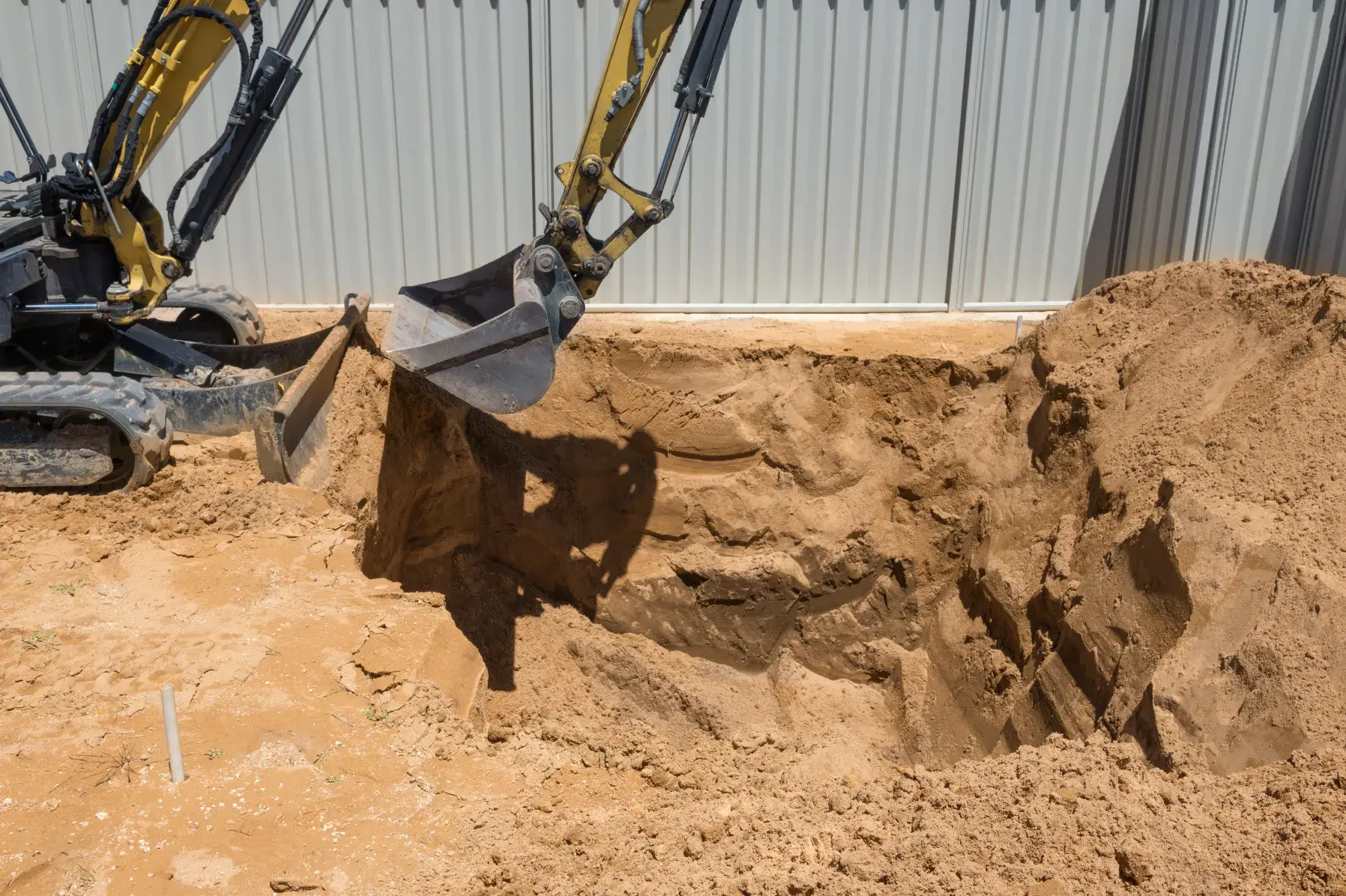
The single biggest "uh oh" moment on a pool job is the day the bucket bites into something that doesn't budge. For some Australian backyards, it is only a small patch of weathered rock that slows the job down for a few hours. For others, it can mean a rock breaker, extra truck loads, a longer excavation window and a bigger trade bill than expected.
If you are working through our Fibreglass Pool Installation Guide, this is one of the key excavation risks to understand before the dig starts. Whether you are organising your own trades for a DIY fibreglass pool install or using a full-service pool builder, rock is one of the main unknowns in swimming pool excavation.
This guide explains what happens when the digger hits rock, how rock is usually identified, the common ways excavators break through it, what realistic 2026 cost ranges can look like and the quote clauses you should check before anyone starts digging.
|
Quick Answer: What happens when swimming pool excavation hits rock? When swimming pool excavation hits rock, the excavator usually stops, checks the type and amount of rock, then decides whether it can be removed with the bucket or needs a ripper, hydraulic rock breaker or rock saw. |
How Often Does Pool Excavation Hit Rock?
Rock is common enough in Australian pool excavation that it should be allowed for in the planning, especially if your block is in a known rock area.
That does not mean every backyard is sitting on a mini Uluru. Plenty of pool digs go through sand, clay or fill without needing a rock breaker. But in the wrong suburb, on the wrong slope, or beside the wrong ridgeline, rock can show up very quickly.
As a practical guide, Australian National Soil Information System mapping suggests excavators are more likely to encounter rock in areas known for sandstone, shale, granite, basalt, limestone, laterite or shallow rock shelves. This can include parts of Sydney, South-East Queensland, regional New South Wales, the Adelaide Hills, Perth foothills, Hobart and other rocky or elevated areas.
Local conditions matter more than the state or city name. Two blocks in the same suburb can behave very differently. One might dig cleanly. The next might hit a sandstone shelf halfway through the pool footprint.
Other surprises can also slow the dig, including:
-
old concrete footings
-
buried builder’s rubble
-
previous retaining wall material
-
old pool or driveway material
-
unexpected fill
The main point is not to panic about rock. It is to plan for the possibility before the excavator arrives.
If you are organising your own trades, ask the excavator how they price rock before accepting the quote. If you are using a full-service installer, ask whether rock is included, excluded or treated as a variation. Either way, get it in writing before the dig starts.
How Rock Is Identified Before You Sign
Three sources tell you what's likely under your block:
-
Geotechnical soil report. A soil engineer drills two or three boreholes to 2–3m and gives you a classification of either A, M, H or P under AS 2870 Residential Slabs and Footings, plus rock notes if any. The cost is usually between $600-$900 for a standard residential site. It’s one of the best budget items you'll spend on a pool project, and the report is yours to keep regardless of who ends up doing the dig.
Knowing you have rock lurking in the location of your pool excavation ahead of time allows you to consider relocating your pool to a rock free area. At the least, you can budget for the additional time and cost of removing the rock rather than getting an unwelcome surprise at once the excavator is onsite. -
Council records. Some councils hold geological mapping for development assessment. Worth a phone call to your planning officer to ask if rock is commonly found in your street or suburb.
-
Talk to the neighbours. Old-school but effective. If three houses up the street had to bring in a rock breaker for their house build or pool installation, yours probably will too.
A reasonable excavator will ask whether you have a soil report before quoting. If you're DIYing the project, ask the trade upfront what the costs will be to remove rock. If you're using a licensed pool installer, ask them whether they've ordered a report or whether they want you to commission one.
The Three Excavation Methods When Rock Shows Up
The standard rig for a pool dig is an excavator with a bucket attachment + bobcat + truck for soil disposal. The excavator pulls spoil out of the ground, the bobcat shuttles it across the yard to the truck, and the truck carts it away. An 8m pool going into sand or clay will generally take around 3-4 hours to excavate plus the time for the truck to cart the material to a tipping site.
If side access is narrower than 3m, the crew has to swap to smaller equipment (mini-excavator, narrow bobcat), which adds time and cost. Allow for an extra half-day for plunge pools and up to two full days on tight blocks for 10m+ pools. The absolute minimum side access is around 900mm, but anything under 3m is the threshold where the price starts moving.
Once the digger meets rock, the excavator has four options.
1. Bucket and tooth (no extra method): A standard excavator with a hard-rock toothed bucket can chew through weathered sandstone, soft limestone, and decomposed granite without too much trouble. This might add 2–3 hours to the dig as it is still slower than digging out sand or clay. No extras invoiced if your trade quote states the bucket method is included.
2. Ripper: A hook-like attachment is fitted in place of the bucket and is dragged through the rock to rip it into small enough pieces for the bucket to scoop up. This is suitable for softer rock, like sandstone or isolated sections of rock. Rippers won’t slow a job down too much; however, budget for at least an extra half day as a minimum.
3. Hydraulic rock breaker (the "jackhammer on a stick"). A breaker attachment fits in place of the bucket and pounds the rock like a jackhammer until it cracks. It is commonly used for harder sandstone, shale, laterite, basalt or weathered granite. Most excavators will charge an additional rate by the hour (usually between $140 and $200) while using the rock breaker, which includes the time to remove and attach the breaker each time it is needed.
4. Rock saw or chain trencher: Cuts a clean line through hard sandstone or fresh granite where a breaker would shatter the surrounding ground. Rare on residential pool jobs, but the right tool for a tight cut on a hardcore excavation. It’s not cheap, though at anywhere between $2,500–$5,000 for a half-day.
What Pool Excavation Rock Costs in 2026
As a planning guide, rock can add anywhere from a few hundred dollars to $10,000 or more to a swimming pool excavation, depending on what the excavator finds.
For many accessible residential sites, a standard pool excavation for an 8m x 4m fibreglass pool may sit around $1,500 to $3,000 as a separate trade line item. Rock work is usually added on top of that unless it is clearly included in the quote.
The figures below are planning ranges, not fixed prices. Rock excavation costs can change depending on:
-
rock type and hardness
-
how much of the pool footprint is affected
-
machine size
-
side access
-
whether a breaker, ripper or saw is needed
-
truck access and spoil removal
-
tip fees
-
operator rates
In other words, rock is not priced by vibes. It is priced by time, machinery, disposal and how stubborn the ground feels like being that day.
|
Scenario |
Method |
Time impact |
Add-on cost |
|
Soft weathered sandstone |
Toothed bucket |
+2–3 hrs |
$800–$1,200 |
|
Medium sandstone shelf |
Bucket + breaker |
+0.5 day |
$800–$1,600 |
|
Hard sandstone or weathered granite |
Breaker |
+1-3 days |
$1,600–$3,000 per day |
|
Fresh granite or basalt |
Breaker + saw |
+1-3 days |
$8,000–$10,000+ |
|
Boulder field |
Breaker + extraction |
+0.5–1 day |
$2,500–$6,000 |
If your block is in a known rock area, a sensible planning allowance is often $2,500 to $10,000 above the standard excavation quote. Not every job will need that allowance, but it is better to plan for rock early than scramble for extra budget while the excavator is already on site.
Rock can also increase disposal costs. Broken rock is heavier than loose soil, and extra truck loads or higher tip fees can add to the final bill.
"Rock Allowance" vs "Rock Excluded": The Clauses to Read
Before swimming pool excavation starts, your quote should clearly explain what happens if the excavator hits rock.
The wording matters because rock can be handled in different ways. None of these options are automatically wrong, but vague wording is where homeowners get caught.
Here are the common quote clauses.
| Quote wording | What it usually means | What to check |
| Rock included to a set depth |
The excavator or installer has included rock removal down to a stated depth, such as 2m. |
What happens below that depth, and what rate applies after the included amount? |
| Rock excluded |
The base excavation price does not include rock. If rock is found, it is charged separately. |
What hourly, daily or cubic metre rate applies? |
| Rock allowance |
A set amount has been allowed for rock work. If the job uses less, you may only pay the actual amount. If it goes over, extra costs may apply. |
Is the allowance capped, refundable if unused, or charged as a fixed allowance? |
| Silent on rock |
The quote does not clearly say what happens if rock is found. |
Ask for written clarification before accepting the quote. |
The clause you do not want is the one that says nothing.
If the quote is silent on rock, two excavation prices can look similar on paper but behave very differently once the dig starts. One might include a clear rock rate. The other might leave you exposed to extras with no agreed method, rate or approval process.
That is not a fun surprise, especially when there is machinery in the backyard and everyone is staring at the same patch of ground.
Questions to ask before you accept the excavation quote
Before you sign or approve the dig, ask:
-
Is rock included, excluded or allowed for?
-
If rock is excluded, what rate applies?
-
Does the rock rate include the operator and machine?
-
Are extra truck loads, tip fees or float fees included?
-
Who approves extra rock work before it continues?
If you are organising your own trades for a DIY fibreglass pool installation, ask the excavator to write the rock rate directly into the quote.
If you are using a full-service pool builder, ask how the rock clause flows through to you. It might be included in the fixed price, excluded as a site condition, or passed through as a variation. Any of those can be reasonable, as long as it is written clearly before the digger turns up.
The Complete Fibreglass Pool kit price does not change because your site has rock. What changes is the excavation trade cost, because rock-breaking, extra time, machinery changes and heavier disposal sit outside the pool kit price.
Practical Rules for the Dig Itself
Over the years, we’ve helped well over a thousand Aussies install a DIY pool. We’ve learnt a few things along the way that we always like to share:
-
Don't excavate more than one week before installation. An open hole is a weather risk - heavy rain or unstable soil can collapse the walls or wash the floor out, forcing a re-dig. Schedule the excavation as close to your shell delivery date as possible so the hole is fresh when the pool drops in.
-
Work from the dig sheet. Every CFPK kit ships with a dimensioned dig sheet so the excavator has clear specs to work from including the depth and width profile, bench positions and floor taper. No guesswork, no "near enough." Every fibreglass pool shell is man-made which means they vary slightly in depth. Always check measure the shell once it arrives onsite. It is quicker and cheaper than having to lift the shell out if the excavation is slightly off.
When the Smart Move Is Designing Around the Rock
Sometimes the cheapest way to deal with rock is not to break through it. It is to plan around it before excavation starts.
This is why a geotechnical report can be worth organising early, especially in known rock areas. If the report shows shallow rock where the pool is planned, you may have time to review the pool location, orientation, depth or shell choice before approvals and excavation bookings are locked in.
Once excavation has started, moving the pool is not a quick fix.
The pool location is usually tied to approved plans, boundary setbacks, engineering, easements, drainage and site access. Shifting it after rock is found may require an amended site plan, updated permit documents and approval before work can continue.
That can mean delays, extra paperwork and more cost.
If rock risk is found early, possible options may include:
-
shifting the pool before approval
-
changing the orientation
-
choosing a smaller shell
-
choosing a shallower model
-
adjusting the finished pool height where suitable
Even a small planning change can sometimes save thousands. Moving the pool 1m or 1.5m away from a rock shelf, or choosing a slightly shallower model, may reduce the amount of rock that needs to be broken and removed.
But this needs to happen early. Once permits are approved and the excavator is on site, the realistic options are usually to break through the rock, manage the variation cost, or pause the job while revised approvals are sorted.
If you are unsure what a soil report, quote or site condition means, CFPK can help explain the likely options and possible ways forward before you commit to the dig.

Frequently Asked Questions
Can fibreglass pools be installed on rocky ground? Yes. A fibreglass pool can usually be installed on rocky ground as long as the excavation is completed to the correct shape, depth and base requirements. Rock mainly affects the dig, machinery, timing and cost. Once the hole is prepared properly, the shell installation process is much the same.
Should I get a soil report before quoting a pool? If your block is in a known rock area, a geotechnical soil report is often worthwhile before excavation is booked. It will not guarantee every part of the pool footprint, but it can identify likely rock risk, help with planning and make excavation quotes easier to compare.
Can I move the pool if excavation hits rock? Not quickly. Once the pool location is approved, moving it may require an amended site plan, updated permit documents and approval before work can continue. If you are worried about rock, it is better to investigate early and review the pool position before approvals and excavation are locked in.
Who pays if rock is found during pool excavation? It depends on the quote or contract. Rock may be included, excluded, allowed for, or charged as a variation. Before excavation starts, ask what rate applies if rock is found and who must approve extra rock work before it continues.
Can CFPK help if I am unsure about rock or excavation quotes? Yes. If you are unsure what a soil report, site condition or excavation quote means, Complete Fibreglass Pool Kits can help explain the likely options and possible ways forward. The goal is to help you understand the risk before you commit to the dig.


