
.svg)









 Affordable Financing
 Fibreglass Pool Install Stages
The pool you'll still be happy with in five years is the one whose upkeep fits how you actually live. Some pool types turn Saturday morning into pool day; others make it a fortnightly job you barely notice.
Maintenance is where fibreglass quietly saves the most in our Fibreglass vs Concrete vs Vinyl Pools comparison, and where concrete owners feel the difference most over a decade.
Upkeep is the same whoever installs the pool, so this one reads the same whether you went DIY or used a builder.
|
Quick Answer Fibreglass is the easiest to maintain. The non-porous gelcoat resists algae, uses roughly 20–30% fewer chemicals, needs brushing about fortnightly rather than weekly, and skips concrete's acid-wash cycle. Vinyl is similarly low-effort day to day, but the water chemistry needs watching to protect the liner. As a guide, annual upkeep runs about $500 to $800 for fibreglass, against $1,200 to $2,000 for concrete. |
The Tasks Every Pool Needs
Whatever it's built from, every Australian pool needs the same basic care:
-
Water chemistry: chlorine (or salt-cell output), pH, alkalinity, calcium hardness.
-
Filtration: enough pump hours to turn the water over one and half times a day.
-
Surface cleaning: skimming leaves and debris.
-
Wall and floor cleaning: brushing or vacuuming.
-
Emptying skimmer and pump baskets.
-
Backwash or cartridge clean, depending on the filter.
-
Equipment checks: salt cell, filter pressure, pump.
Pool type changes how often, how hard, and how chemical-heavy each of those is. Here's the cadence.
Daily: All Three Are Easy
Day to day, the difference is small. The robotic cleaner does the floor and walls overnight, the skimmer catches leaves, and the pump runs on its schedule. Owner involvement is five minutes or less for any pool type, empty the cleaner basket, glance at the filter gauge, done. The gap opens up at the next level.
Weekly: Where Concrete Loses
Weekly is where it separates. For a typical mid-size pool in summer:
-
Fibreglass, around 30 minutes. Test the water, empty the baskets, a quick skim, a fortnightly brush of the waterline, and top up chemicals. The smooth surface means algae rarely gets going.
-
Concrete, 45 to 60 minutes. All of the above, plus weekly brushing of the walls and floor, because the rough, slightly porous surface holds biofilm, more chemicals to keep on top of it, and a look through the shaded corners for algae.
-
Vinyl, 30 to 40 minutes. Similar to fibreglass, with a bit more care on chemistry to protect the liner, and a periodic check of the liner seams for early wear.
That 15-to-30-minute weekly gap between fibreglass and concrete adds up. Across a six-month season it's a solid chunk of weekends, and across 20 years of ownership, hundreds of hours.
Monthly and Quarterly
Monthly tasks (backwash or clean the filter, check and clean the salt cell, check the equipment housing) are similar across all three. Quarterly, the cadence diverges a little: calcium hardness matters more on concrete and vinyl, a full water panel is worth doing on any pool, and concrete gets a spot-check for staining and biofilm while vinyl gets a look over the seams.
Fibreglass has no equivalent surface task, the gelcoat just keeps doing its job.
Annual Big Bills
The yearly cycle is where the real difference compounds. As a guide, all-in annual upkeep runs about $500 to $800 for fibreglass, $1,200 to $2,000 for concrete, and $800 to $1,200 for vinyl. On top of that sit the big-ticket events:
-
Fibreglass. Routine equipment service and the odd salt-cell or filter-media replacement. The gelcoat generally lasts the life of the shell, so there's no resurfacing bill.
-
Concrete. All of the above, plus an acid wash every few years to strip biofilm and stains, occasional spot repairs, and a full resurface every 10 to 15 years at $6,000 to $15,000 as a guide.
-
Vinyl. Standard equipment work plus a new liner every 5 to 10 years at $3,000 to $6,000 each, which averaged out is a real annual cost even though it lands in a lump.
We put the full dollars side by side in Lifetime Cost Analysis: Which Pool Type Saves Money?
Time Cost: Hours a Week
|
In-season time |
Fibreglass |
Concrete |
Vinyl |
|
Daily (averaged) |
~5 min |
~5 min |
~5 min |
|
Weekly |
~30 min |
45–60 min |
30–40 min |
|
Monthly tasks |
~30 min |
~45 min |
~35 min |
|
Annual big bills |
Gel coat lasts the shell's life |
Resurface + acid-wash cycle |
New liner every 5–10 yrs
|
Off-season, the times drop across the board, though concrete still leads on total effort because algae doesn't fully stop in the warmer states through winter.
Climate plays into all of this, and which pool type handles Australian weather best digs into how your region changes the workload.
Equipment That Cuts the Effort
A few investments genuinely reduce the burden, and the gains apply equally across all three pool types:
-
Variable-speed pump. Quieter, cheaper to run, and lets you run long low-speed cycles that keep the water moving without hammering the power bill.
-
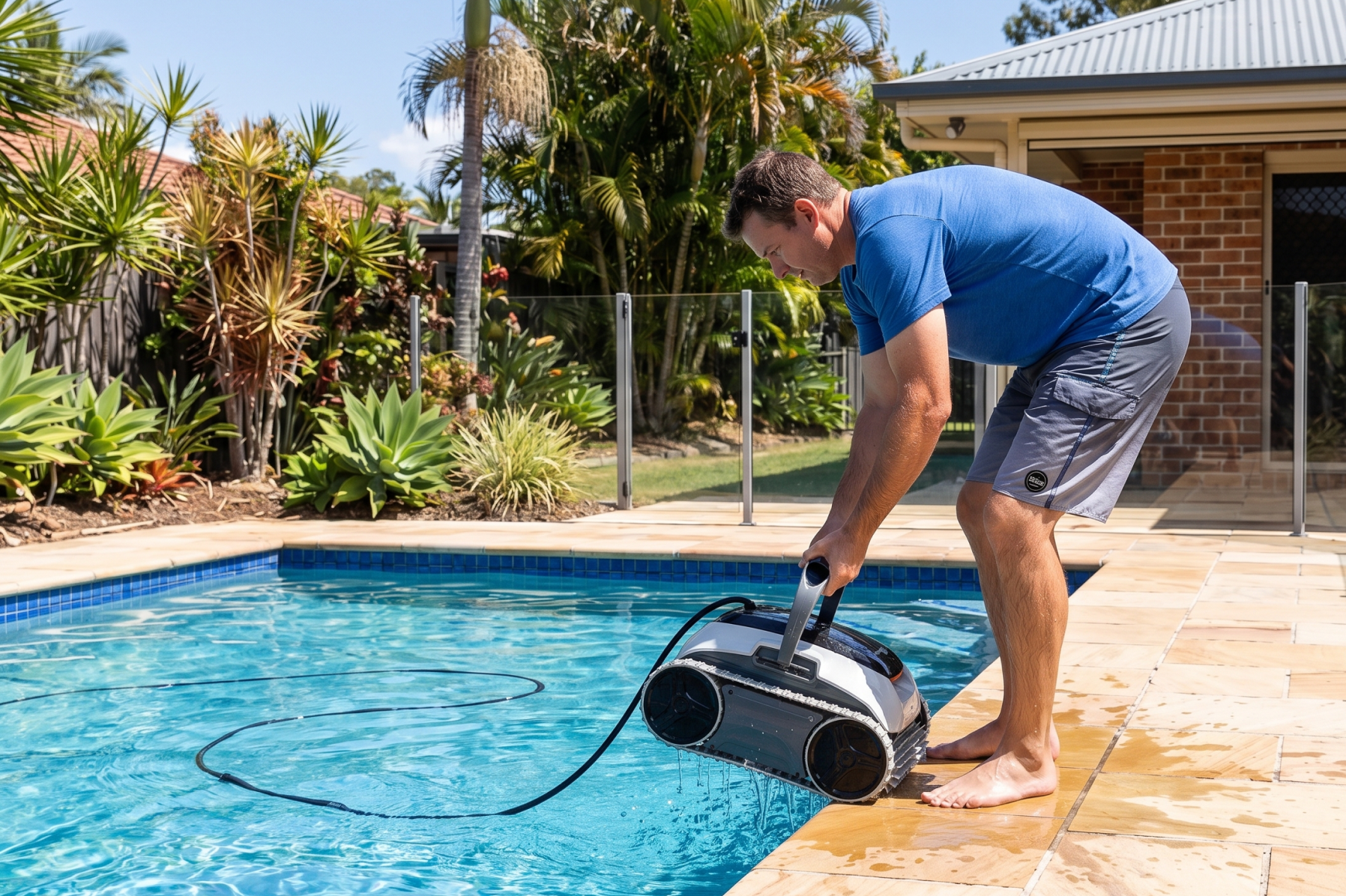
Robotic cleaner. Does the daily floor and wall cleaning you'd otherwise be doing yourself. A quality unit is a few hundred to a few thousand dollars and earns its keep in time saved.
-
Salt chlorinator. Far less hands-on than dosing liquid chlorine, the cell makes the sanitiser for you.
-
Pool cover. A solar cover sharply cuts evaporation (commonly cited at around 90%), reduces chemical loss and steadies the water temperature. A big maintenance saver, especially inland and in the tropics.
For the deeper how-to on keeping a fibreglass pool in top shape, see our Fibreglass Pool Maintenance Masterclass.

Frequently Asked Questions
Which pool type is easiest to maintain? Fibreglass, clearly. The non-porous gel coat resists algae, chemical demand is roughly 20–30% lower than concrete, and brushing is fortnightly rather than weekly.
Do fibreglass pools really need fewer chemicals than concrete? Yes, by a meaningful margin. Concrete's porous interior holds biofilm and algae, so it needs more chlorine and more balancing. That's a big part of why fibreglass upkeep runs about $500 to $800 a year against $1,200 to $2,000 for concrete.
How long does pool maintenance take each week? For a fibreglass pool with a variable-speed pump, robotic cleaner and salt chlorinator, around 30 minutes a week in summer. Concrete is more like 45 to 60. Vinyl sits between the two.
What's the most time-saving equipment to invest in? A robotic cleaner is the single biggest hassle-reducer. A pool cover is next, especially inland or in the tropics where evaporation is high.
Do concrete pools really need acid washing? Yes, every few years for a plaster-finished concrete pool, to strip biofilm, mineral deposits and surface stains. Fibreglass doesn't need it at all.


