
.svg)









 Affordable Financing
 Fibreglass Pool Install Stages
Can a fibreglass pool really float or lift out of the ground?
Yes, it can. But it does not happen without good reason, and it is not simply because the fibreglass shell is lightweight. The real issue is groundwater.
If water builds up around the outside of the shell and rises above the water level inside the pool, it creates upward pressure. If that pressure cannot be controlled, the pool may start to lift.
As part of our Fibreglass Pool Installation Guide series, this article explains what causes lifting, which sites carry more risk and how a correct fibreglass pool installation prevents it.
|
Quick Answer Yes, a fibreglass pool can lift out of the ground when groundwater rises above the water level inside the pool. On genuinely free-draining sandy ground, water drains away and pressure cannot normally build around the shell. On clay, rock and other slow-draining sites, suitable subsoil drainage, an accessible standpipe and a correctly installed hydrostatic relief valve are the key safeguards. The pool’s weight and concrete bond beam do not stop flotation. Controlling the water around the pool does. |
What Causes a Fibreglass Pool to Float?
A fibreglass pool can lift when groundwater outside the shell rises above the water level inside it and that pressure has nowhere to go.
This is called hydrostatic pressure. “Hydro” means water, so hydrostatic pressure is simply the pressure created by water sitting around and underneath the pool.
Think of an empty bucket pushed into a tub of water. The water underneath wants to push the bucket back up. A fibreglass pool can behave in a similar way when groundwater becomes trapped around the shell.
The key issue is not how heavy the pool is. It is the difference between:
-
the water level inside the pool
-
the groundwater level outside the pool
When the water inside the pool sits higher, it helps balance the pressure outside the shell. When groundwater rises higher, the upward pressure increases. If that water cannot drain away, be pumped out or be relieved through the hydrostatic valve, the shell may begin to lift.
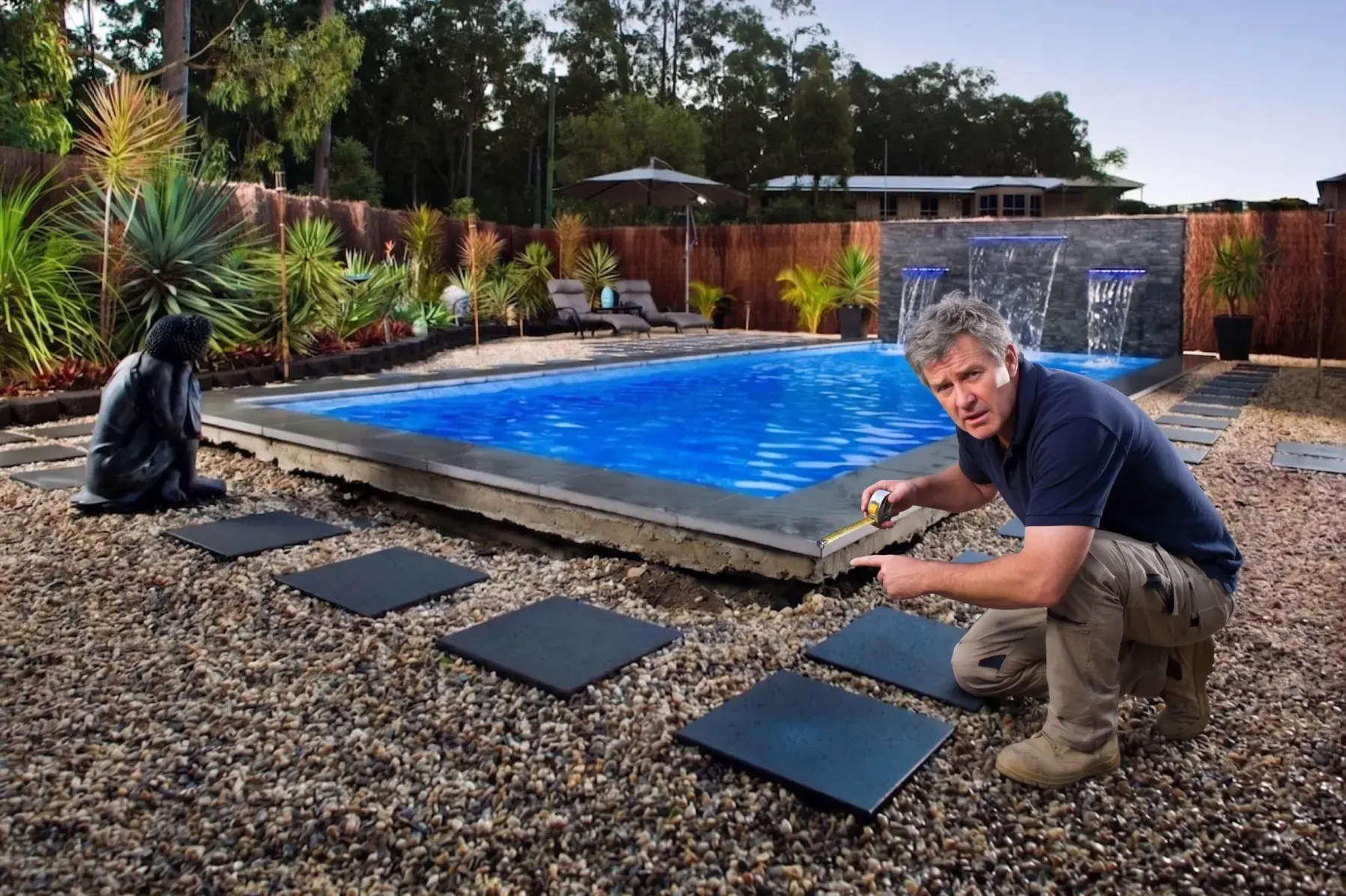
We have seen a 10-metre fibreglass pool installed in clay, holding about 70,000 litres or 70,000 kg of water and surrounded by a substantial concrete bond beam, lift roughly 200 mm after three days of non-stop rain. The pool had been installed too low and the site drainage was not adequate.
Water does not care how impressive the bond beam looks. If the pressure is not controlled, it will find a way to cause trouble.
What Stops a Fibreglass Pool from Floating?
A correctly installed fibreglass pool relies on four main safeguards:
-
the pool is installed at the correct height
-
surface water is directed away from the pool
-
subsoil drainage is installed where the ground does not drain freely
-
a hydrostatic relief valve and accessible standpipe are installed correctly
Get these four things right, and you remove the conditions that normally allow a shell to lift. They are simple to include during the original installation and much harder to retrofit once the concrete, paving and landscaping are finished.
Which Soil Types Increase the Risk of a Fibreglass Pool Floating?
Clay and rock create the greatest flotation risk because they can trap groundwater around the pool. Free-draining sand is far less concerning because water can escape before pressure builds around the shell.
The key question is simple:
| Ground condition | General risk |
What happens |
| Free-draining sand |
Low |
Water drains away instead of sitting around the shell |
| Clay |
Higher |
Water drains slowly and may remain around the pool for days or weeks |
| Rock |
Higher |
The excavation can act like a bathtub and hold water |
| Sloping ground |
Site-dependent |
Water may travel downhill and collect against the pool |
| Low-lying ground |
Higher |
Surface water and groundwater naturally collect in the area |
Free-draining sand
On genuinely free-draining sandy ground, groundwater does not normally remain around the pool long enough to create uplift pressure. AS 1839:2021 recognises this. The Standard provides an exception to the hydrostatic-valve requirement where the soil is free-draining and the water table cannot rise above the pool floor.
Do not assume a block is free-draining. A block may look sandy at the surface but have clay, rock or compacted fill further down. The full excavation needs to drain, not just the first 300 mm.
Clay
Clay absorbs water slowly and releases it even more slowly. After heavy rain, the lawn may look dry while groundwater is still sitting around the deep end of the pool.
On clay sites, preventative subsoil drainage gives that water somewhere to go before pressure builds around the shell.
Rock
A pool excavation cut into rock can act like a large bathtub. Water gets in through rain, seepage or cracks in the rock, but it cannot soak away quickly.
Without suitable subsoil drainage and a pumping point, that water may remain trapped around the pool.
Sloping and low-lying sites
Water naturally travels downhill, including below the surface. On a sloping block, groundwater may travel through the soil and collect against the uphill or deep side of the excavation. On a low-lying site, water may collect around the entire pool area.
These conditions do not rule out a fibreglass pool. They simply mean the drainage needs to be planned before excavation, not after the hole starts filling with water.
How High Should a Fibreglass Pool Be Installed?
AS 1839:2021 requires the water level in the pool to be at least 50 mm above the highest adjacent ground level, unless the site meets the Standard’s free-draining or fully piped drainage provisions.
The finished concrete or paving must also fall away from the pool so surface water runs away from the shell. That 50 mm is the minimum requirement.
In practice, many installers set the top of the fibreglass shell around 100 to 150 mm above natural ground level.
This gives them extra room to:
-
create fall away from the pool
-
stop rainwater draining towards the shell
-
provide a practical buffer above saturated ground
-
maintain a comfortable difference between the water inside the pool and groundwater outside it
The extra height is a practical buffer. It is not a separate requirement under the Standard.
Why the extra buffer helps
On a badly waterlogged site, groundwater can rise to the surface and even run across the top of the ground. At the same time, the pool will usually be full from the rain and may be overflowing.
Where the pool has been installed at the correct height, the water inside the shell still sits higher than the groundwater around it. That keeps the pressure balance working in the right direction.
Do not install the shell too low
Installing a fibreglass pool too low is not a minor problem. Once the shell has been backfilled and the coping, paving or concrete is finished, correcting the height generally means lifting the pool out and starting again.
There is no clever shortcut. No magic bag of grout. The pool needs to be installed at the right level the first time.
What Drainage Does a Fibreglass Pool Need?
A fibreglass pool needs enough drainage to stop surface water and groundwater collecting around the shell. The right setup depends on the soil, slope, groundwater and how water moves across the property.
Good fibreglass pool drainage is not just a strip drain beside the paving. You need to look at the whole site before excavation begins.
Check:
-
which way the block falls
-
where rainwater currently travels
-
whether the soil is sand, clay, rock or fill
-
whether water collects in the proposed pool area
-
whether retaining walls sit uphill
-
whether neighbouring properties drain towards you
-
whether the block is low-lying or flood-prone
-
where collected water can legally discharge
-
how future paving and landscaping may change water flow
Surface drainage
Surface drainage manages rainwater travelling across the top of the ground.
This may include:
-
paving or concrete that falls away from the pool
-
strip drains
-
grated drains
-
stormwater pits
-
correctly directed downpipes
-
landscaping that does not send water towards the shell
A drain is only useful if the water has somewhere suitable to go.
Sending it from one side of the pool to the other is not a drainage plan. It is just relocating the puddle.
Subsoil drainage
Subsoil drainage manages water travelling through the ground. It is particularly important on slow-draining, sloping or low-lying sites and where retaining walls interrupt the natural movement of water.
On these blocks, preventative subsoil drainage may be the most important part of stopping a fibreglass pool from lifting. Water always takes the easiest path. Make sure that path leads away from the shell, not into the excavation.
Later changes matter too.
A new retaining wall, garden bed, shed slab or paved area can redirect water towards a pool that previously drained properly.

What Do the Hydrostatic Valve and Standpipe Do?
The hydrostatic relief valve releases pressure beneath the shell, while the standpipe allows groundwater to be checked and pumped away.
They work together, but they do different jobs.
| Component | What it does |
| Hydrostatic relief valve |
Allows groundwater beneath the shell to enter the pool when external pressure becomes too high |
| Standpipe |
Provides access to check groundwater levels and pump water away from around the pool |
Hydrostatic relief valve
The hydrostatic relief valve is normally installed at or near the deepest part of the pool. Under normal conditions, it stays closed.
If groundwater pressure beneath the shell becomes too high, the valve allows that water into the pool. Dirty groundwater entering the pool is not ideal, but it is a much better outcome than the pressure lifting the shell.
The valve is a pressure-relief measure. It is not a substitute for proper drainage.
If the valve opens, do not immediately pump the water straight back out.
First check the groundwater level through the standpipe and work out why the pressure increased.
Standpipe
The standpipe gives you access to the area around and beneath the pool.
It allows you to:
-
see whether groundwater is present
-
check how high it has risen
-
lower a suitable pump hose into the system
-
reduce the water level outside the shell when required
The standpipe is particularly important during installation and before draining the pool for maintenance or repairs.
Do not bury it under concrete, paving or landscaping. It needs to remain accessible.
AS 1839:2021 includes specific provisions for hydrostatic pressure relief valves and standpipes as part of groundwater management around fibreglass pools.
When Is a Fibreglass Pool Most Likely to Lift?
A fibreglass pool is most at risk during installation, when the shell is sitting in the excavation but the pool has not yet been fully filled with water.
It can also be at risk later if the pool is drained or groundwater rises during prolonged rain or flooding.
During installation
In our experience, this is when the risk is highest.
Before the shell goes into the ground, check:
-
What type of soil is in the excavation?
-
Where will surface water and groundwater go?
-
Is the ground already wet or waterlogged?
-
What rain is forecast during the installation?
-
Can water entering the excavation be pumped out quickly?
The weather check is critical. If the ground is already waterlogged, even a small amount of rain can fill the bedding area and build water around the shell.
Once the shell is in position, that water can rise quickly. If it gets higher than the water level inside the pool, the shell may begin to lift. If this happens, the pool cannot normally be pushed back down and the installation continued. The shell needs to come out so the bedding can be checked and re-contoured before the pool is installed again.
That means more machinery, more labour and a very expensive way to learn that the forecast mattered.
Do not lower the shell into a wet excavation and hope the sun comes out. If rain is forecast and the ground cannot absorb or drain the water, postpone the installation or have an effective pumping plan ready before proceeding.
Once the shell is positioned and the standpipe is installed, use it to monitor groundwater throughout filling and backfilling.
When the pool is drained
A fibreglass pool can be at risk whenever the internal water level is substantially lowered. This can happen at any time of year, even when the surface of the yard looks dry.
Always check the groundwater through the standpipe before draining the pool.
During flooding or prolonged rain
Monitor groundwater through the standpipe and pump it down if required. Keep the pool full unless the shell supplier or a suitably qualified pool professional advises otherwise. A basic transfer pump is inexpensive compared with removing and reinstalling an entire pool.
Dirty pool water can be treated later. A lifted shell is a much bigger weekend project.
Does the Concrete Bond Beam Stop a Fibreglass Pool from Floating?
No.
The bond beam provides structural support for the coping and surrounding concrete or paving. It is not there to act as a giant weight that holds the shell down. A large bond beam will not save a pool installed too low in a waterlogged excavation with no working drainage.
The same applies to the backfill.
Backfill supports the walls of the shell and helps the pool maintain its correct shape. It does not replace drainage, a standpipe or a hydrostatic relief valve.
What Should You Do Before Draining a Fibreglass Pool?
Do not drain a fibreglass pool unless there is a genuine reason and the groundwater level has been checked.
Before lowering the pool-water level:
-
Read the shell manufacturer’s instructions and warranty conditions.
-
Contact the shell supplier, installer or a suitably qualified pool professional.
-
Check the groundwater through the installed standpipe.
-
Pump down external groundwater if required.
-
Plan the work so the pool is not left empty longer than necessary.
-
Keep monitoring the standpipe until the pool is refilled.
Draining a fibreglass pool without following the manufacturer’s process may affect warranty coverage.
Can You Safely DIY a Fibreglass Pool Installation?
Absolutely.
For most homeowners, managing a DIY fibreglass pool installation is very achievable. Pool flotation is a worst-case scenario. Most pool owners will never deal with it.
Get the finished levels, drainage, hydrostatic valve and standpipe right and you will most likely own the pool for 20 years or more without ever dealing with it lifting. Working out the finished pool height is also simpler than it may sound.
Your excavator can use a laser level to confirm the highest adjacent ground, the finished pool-water level and the required fall away from the shell. It is a straightforward check, but it needs to be agreed before excavation begins.
The important part is sorting it out early, not standing around the hole halfway through the job asking who brought the laser.
Complete Fibreglass Pool Kits has helped more than 1,000 Australians successfully manage their own fibreglass pool installations.
Our customers receive:
-
a copy of AS 1839:2021
-
plain-English installation guidance
-
explainer videos showing how the hydrostatic valve and standpipe are installed
-
practical support when they need help working through the requirements
Where a site has unusual groundwater, difficult rock, reactive clay or other complications, you may also need advice from an engineer or another competent person.
For most projects, though, the process is straightforward:
-
understand the soil
-
set the levels with a laser
-
plan the drainage
-
install the standpipe and valve correctly
-
follow the installation guidance
If concerns about pool flotation are making you lean towards concrete, the important comparison is not simply shell weight. It is how each pool is designed and installed to manage groundwater on your site.
The Bottom Line: Get the Drainage Right and the Pool Stays Put
Yes, a fibreglass pool can float, but most owners will have their pool for decades without ever experiencing it.
It is a real installation risk, but it is not something most owners will ever experience or a reason to rule out fibreglass.
Understand the soil, set the finished levels correctly and give groundwater somewhere to go.
Planning a DIY fibreglass pool installation? Send Complete Fibreglass Pool Kits your site details, photos and any information you have about the soil or slope. We can help you understand the likely drainage requirements and point you in the right direction before excavation begins.

Frequently Asked Questions
Does a high water table mean I cannot install a fibreglass pool? No. A high water table does not automatically rule out a fibreglass pool, but the groundwater must be properly managed. The installation may require subsoil drainage, a standpipe, pumping arrangements and site-specific advice. It should not be approached in the same way as a straightforward, free-draining site.
Do all clay or rock pool sites need an engineer? Not always. Many clay and rock sites can be managed with correct levels, suitable subsoil drainage, a standpipe and a hydrostatic valve. Engineering or other competent advice may be needed where there is reactive clay, significant groundwater, unstable rock, retaining walls, steep slopes or another unusual condition.


