.svg)









 Affordable Financing
 Fibreglass Pool Install Stages
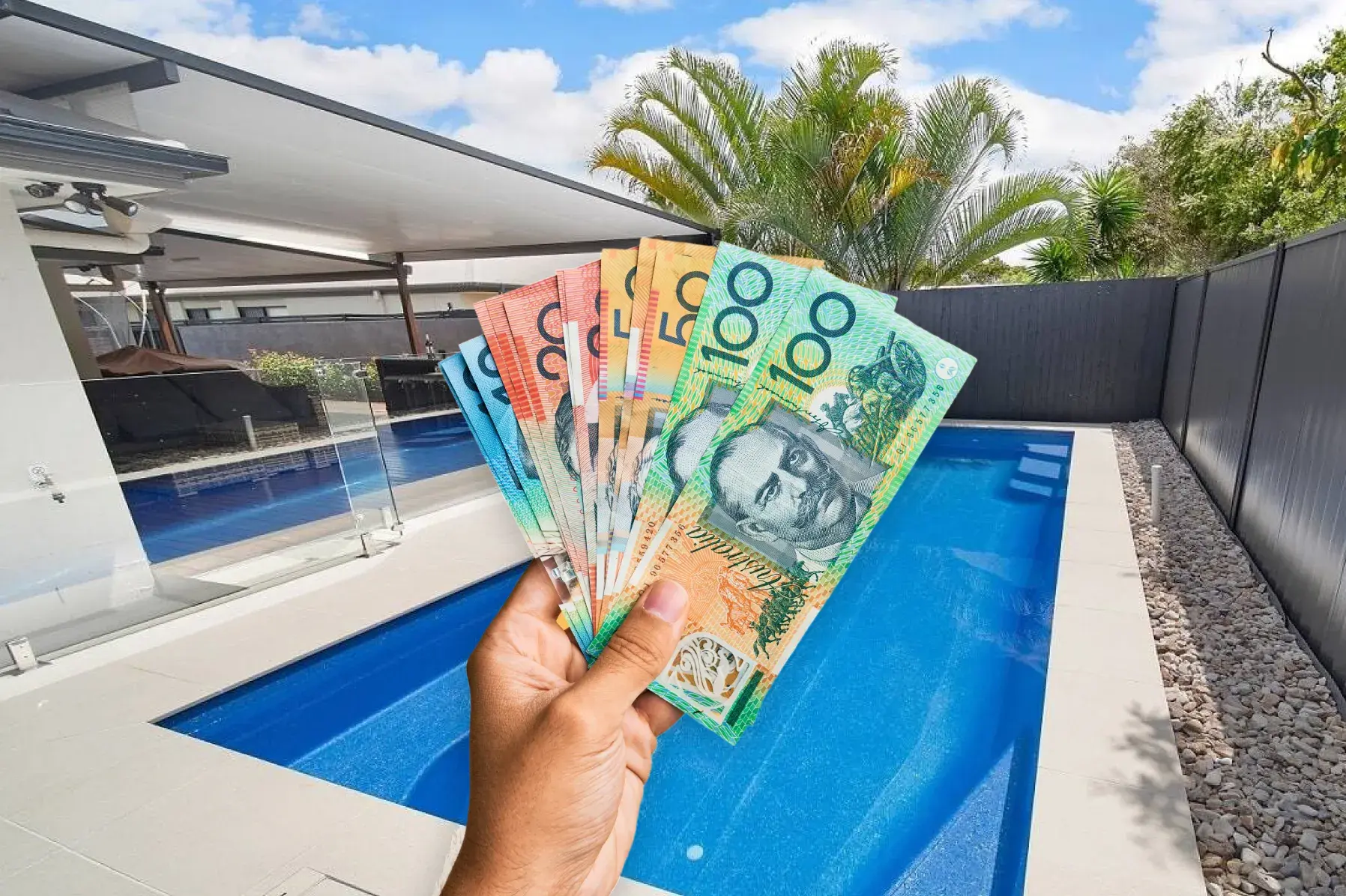
Build cost is the conversation everyone has. Running cost is the one buyers forget until the summer power bill lands. Here's the realistic 2026 line-by-line breakdown of pool running costs in Australia. The build price is the headline; the running cost is the long tail. Together they make up the full picture covered in our Complete Fibreglass Pool Cost Guide This article breaks the running figures down line by line.
|
Quick Answer How much does it cost to run a pool in Australia? In 2026, most self-managed fibreglass pools cost around $890-$2120 per year to run. This includes electricity, chemicals, water, cleaning supplies, minor maintenance and insurance increases, but not major equipment replacement. Pool servicing can add $1,500-$2,100 per year, while heating can add $400-$1200+ per year, depending on location and usage. The cheapest pools to run usually use a variable-speed pump, a pool cover and daytime filtration matched to solar power. |
Average Pool Running Costs Per Year Australia:
A typical 7m fibreglass family pool in 2026, self-managed by the owner, runs:
|
Cost line |
Annual range |
Mid-point |
|
Electricity (pump + filter) |
$400 - $850 |
$600 |
|
Chemicals (salt/minerals, buffers, acid) |
$250 - $500 |
$375 |
|
Top-up water |
$40 - $120 |
$80 |
|
Cleaning supplies (filter cartridges, etc.) |
$75 - $100 |
$85 |
|
Equipment minor maintenance |
$50 - $200 |
$125 |
|
Insurance increment |
$50 - $300 |
$200 |
|
Sub-total (no heating, self-managed) |
$890 - $2,120 |
$1,480 |
|
Heating (if used, climate-dependent) |
$400 - $1200 |
varies |
|
Pool service (if used, fortnightly) |
$1500 - $2100 |
$1,800 |
|
Realistic owner total |
$2765 - $5360 |
depends on choices |
For the upfront cost picture, check out the fibreglass pool cost guide, which walks through every line.
Electricity: The Biggest Single Variable
Pool electricity is dominated by one piece of equipment: the pump. For non-heated pools, the pump is usually the dominant electrical load. Heated pools are different, with heating often becoming the single largest running cost. Electricity costs vary significantly depending on state, tariff structure, solar export arrangements and pump runtime settings.
Single-speed pump. Older pools or budget builds. Runs at one speed (usually 1.0-1.5HP) and uses 1,000-2,000 watts continuously. Running 6-8 hours a day in summer, this costs $900-$1,400 a year.
Variable-speed pumps are now widely considered the modern standard for energy-efficient pool operation. Runs at the lowest required speed for filtration (often 800-1,200 RPM, drawing 100-400 watts). Cost: $200-$400 a year. Pays back the price difference vs single-speed in 12-18 months for most pools.
See the full deep-dive on variable speed vs single speed pool pump.
Other electrical loads.
• LED pool lights: $5-$15 a year if used 1-2 hours a night.
• Salt chlorinator: $40-$120 a year (roughly 200-400 watts when active).
• Robotic cleaner: $20-$50 a year.
Solar offset. A pool plumbed to run primarily during daytime hours can match its pump load against household solar generation. With a typical 6-10kW residential solar system, the pump load is fully covered most days, significantly reducing net electricity costs in many households. For homeowners with solar, this is the single biggest running-cost lever.
Chemicals: The Steady Drip Cost
A salt-chlorinated fibreglass pool in 2026 typically costs $250-$500 a year for chemicals. Composition:
• Salt top-ups: $40-$120 a year (you don't need to add salt often - mostly after rain dilution or if your pool is losing a lot of water from evaporation or weekly bombie competitions)
• pH balancer (acid + buffer): $80-$150.
• Calcium hardness adjuster: $30-$60 if needed
• Stabiliser (cyanuric acid): $20-$40 a year
• Algaecide (preventative or shock): $20-$60 if needed
• Water clarifier: $20-$80 if needed.
The big variables. Pools in hard-water areas (parts of Adelaide, parts of WA) need more pH and calcium management. Pools in soft-water areas (most of Sydney, Melbourne) are cheaper. Tree-heavy yards add $50-$150 a year in algae control. Pools without a cover use 30-50% more chemicals.
A pool cover (solar blanket or thermal blanket) is the highest-ROI single purchase for cutting chemical cost. A $600 cover saves $150-$300 a year in chemicals plus reduces water loss — typical payback 2 - 4 years.

Water and Top-Up Costs
A 60,000-litre family pool loses 3-7mm of water a day to evaporation in an Australian summer — about 10-25mm a week, depending on heat and wind. Annual top-up:
• Without a pool cover: 12,000-25,000 litres a year.
• With a solar blanket: 1,500-5,000 litres a year (up to 95% reduction under ideal conditions).
At Australian water prices in 2026 (around $2.20-$3.50 per kilolitre, varying by state and council), top-up water costs:
• Without cover: $30-$90 a year.
• With cover: $5-$20 a year.
Plus fortnightly (cartridge filter) or monthly (sand filter) cleaning - 150 - 300 litres each time
Drought and water restrictions. In WA and parts of regional Australia, restrictions can apply to filling new pools. Most allow new pool fills with a permit, but check your state water authority before buying.
Pool Service vs Self-Managed: The DIY Question
Pool service is the optional line. Many pool owners self-manage their maintenance, while others prefer regular servicing. The price ladder in 2026:
• Self-managed. Time cost: 30-60 minutes a week in season including a weekly trip to the pool shop for a water test, less off-season. Out-of-pocket: only the chemicals and supplies as listed above.
• Monthly service visit. $80-$140 per visit. Annual: $960-$1,680. Owner still does weekly skimming and water testing.
• Fortnightly full service. $60-$80 per visit, plus chemicals (sometimes itemised, sometimes included). Annual: $1,500-$2,100. Owner does almost nothing.
• Weekly white-glove. Premium suburbs only. $80-$150 per visit. Annual: $4,000-$8,000. Pool always perfect.
The DIY comparison. A robotic cleaner ($900-$2,000 every 4-7 years), a $30 test kit, and 30 minutes a week replaces a $1,800/year service. Most pool owners with the time and inclination DIY for that reason.
For owners who travel a lot or don't enjoy maintenance, a service is a reasonable spend and pool services usually catch chemistry issues early, which can prevent the cost of treating an algae bloom or cloudy water.
Equipment Depreciation: The Slow Annual Hit
Equipment doesn't fail catastrophically. It wears slowly.
• Single Speed Pool pump (4-year life): $200-$250 a year.
• Pool filter (12-year life): $60-$260
• Salt cell (5-year life): $140-$300
• Salt chlorinator controller (10-year life): $120-$170.
• Pool lights (10-year life): $30-$60
• Robotic cleaner (5-year life): $250-$500
• Pool cover (10-year life): $60-$150
Total annual equipment depreciation: $640-$1,460. This isn't an out-of-pocket cost in any given year — but it's the long-term cost of equipment that you'll feel as replacement bills every 5-12 years.
Setting aside a modest maintenance reserve each year can make future equipment replacement much less stressful. A $70,000 pool with a $5,000-$7,000 replacement reserve over 10 years comfortably covers the equipment refresh that year 10-12 inevitably brings.
We’ve created a truthful big picture of the hidden costs of pool ownership in Australia.
Three Simple Ways to Cut 30%+ Off Your Annual Bill
Most owners can take a meaningful chunk off their annual pool running costs without much effort:
1. Variable-speed pump. If you're still on a single-speed pump, replacing the pump with a variable speed pump cuts $700-$1,000 a year off the electricity bill. Payback 12-18 months.
2. Solar pool cover. Saves $150-$400 a year on water and chemicals. Reduces evaporation by 95%. Usually pays back in under three years.
3. Solar electricity offset. A 6-10kW residential solar system covers most of the pump load on most days. Cuts pool electricity to near zero in many setups. The system pays for itself across the whole house, but the pool is a meaningful chunk of the win.
Stacking all three on a typical $1,800/year owner-managed pool drops the annual cost to $700-$1,000 — a reduction of 40-50%.
Frequently Asked Questions
Are fibreglass pools cheaper to run than concrete? Fibreglass pools are often cheaper to run than concrete pools because the smooth gelcoat surface typically requires less chemical correction and resists algae more effectively.
What's the single biggest running cost on a pool? Electricity, in most cases, particularly if you have a single-speed pump and run it 6-8 hours a day. Heating is bigger if you use it; otherwise, the pump dominates.
Can a pool actually run for free with solar? Almost. Pool filtration to run during daytime hours, with a residential solar system covering the load, can operate with very low net electricity costs when pump schedules align with daytime solar generation. Chemicals and water still cost real money.
Should I get a pool service? If you're confident with chemistry, a robotic cleaner and 30 minutes a week (less in colder months when the pool is not being used) beats most fortnightly services on cost. If you travel or don't enjoy maintenance, a service is a reasonable spend and tends to catch issues early.


