










 Affordable Financing
 Fibreglass Pool Install Stages
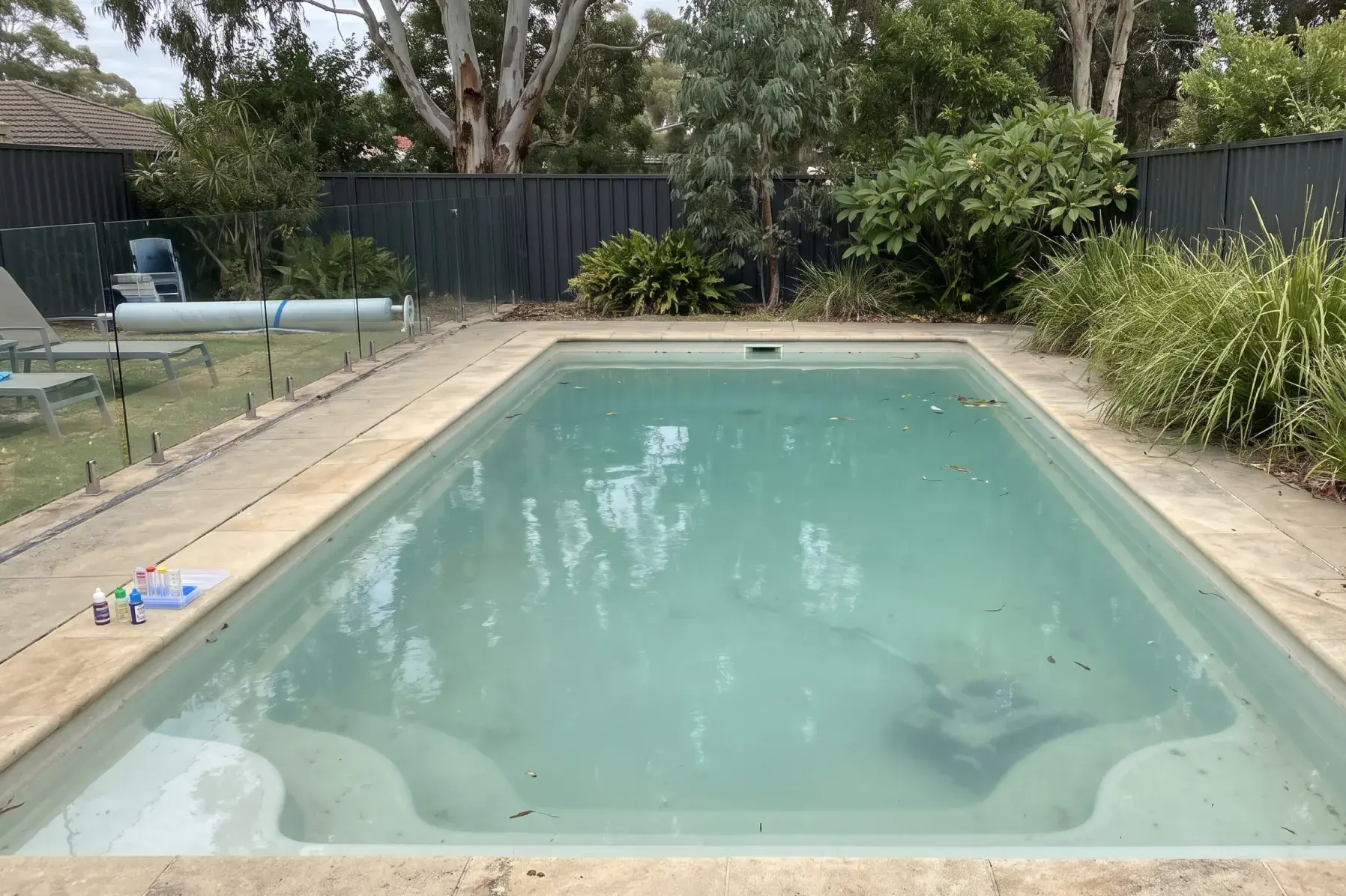
Yesterday your pool was crystal clear. Today you can barely see the bottom. Naturally, it's the day you've promised the kids a swim.
Cloudy pool water is a common problem, and fortunately, most causes are relatively straightforward to fix. The trick is working out what's causing it before you start adding chemicals. Otherwise, you can spend a small fortune at the pool shop and end up with water that's just as cloudy as when you started.
In this guide, we'll explain the common causes, how to identify what's gone wrong and what you can do to get your pool looking its best again. It's all part of keeping your pool in great condition, which we cover in our fibreglass pool maintenance guide.
|
Quick Answer Why is my pool water cloudy, and how do I fix it? Cloudy pool water is usually caused by unbalanced water chemistry, insufficient chlorine, poor filtration or contaminants such as dust, sunscreen and algae. Start with a water test, remove any debris and check that your pump and filter are working properly. Correct any chemical imbalances and allow sufficient filtration time. Most mild cases improve within a day or two, although more serious problems can take longer. Avoid adding chemicals until you've identified the likely cause. |
What Causes Cloudy Pool Water?
Pool water becomes cloudy when tiny particles in the water prevent light from passing through clearly. Sometimes those particles are dirt or organic matter. Other times, minerals have come out of solution, or algae has started growing.
There are five common causes worth investigating.
1. Unbalanced Water Chemistry
High pH, excessive calcium hardness or high alkalinity can cause dissolved calcium to form tiny particles that make your pool water look milky.
It's particularly common when several water chemistry levels are out of balance at the same time. High calcium hardness on its own isn't always the problem. It's how the calcium interacts with pH, alkalinity and water temperature that matters.
2. Insufficient Chlorine or Early Algae Growth
Chlorine sanitises your pool by killing bacteria and controlling algae. If chlorine levels fall too low, algae can start developing before you see the familiar green patches on your pool walls.
Early algae growth can give the water a dull, cloudy or slightly green appearance. If the walls or steps also feel slippery, algae becomes a stronger suspect.
3. Poor Filtration
Your pool filter removes the fine dirt and particles suspended in the water. If it's dirty, blocked or not receiving enough water flow, those particles remain in your pool.
Sometimes the issue is as simple as a blocked skimmer basket or insufficient pump runtime. Other times, it may be a damaged filter cartridge or a problem with the filter media.
4. Heavy Swimming Activity
A pool full of kids on a hot summer afternoon is wonderful for everyone except, perhaps, your pool's filtration system.
Sunscreen, body oils, perspiration and other contaminants all enter the water when people swim. A busy weekend can leave your filter with more work to do and increase the amount of chlorine needed to maintain proper sanitisation.
5. Environmental Contamination
Dust storms, bushfire ash, pollen, construction dust and heavy rainfall can introduce fine particles into your pool.
If you live near gum trees, you'll also be familiar with the seemingly endless supply of leaves, bark and other bits and pieces they generously donate to your backyard.
These contaminants can create cloudy water, particularly when they're too fine for your filter to remove quickly.
A useful clue: Milky-white water can point towards mineral imbalance, while greenish water may suggest algae. Cloudiness appearing after a storm or pool party often points towards contamination. These are clues rather than diagnoses, so test the water before deciding on a treatment.
How to Fix Cloudy Pool Water: Step by Step
The simplest way to fix cloudy water is to work through the possible causes in a sensible order.
You don't need to do everything below. Once you've found the problem, concentrate on correcting it rather than moving through every treatment just because it's on the list.
Step 1: Test Your Pool Water
Before adding anything to your pool, find out what the water chemistry is doing.
You can use a quality home test kit, although taking a water sample to your local pool shop is often the easiest option. Most Australian pool shops offer water testing at no charge.
Ask them to check:
-
Free chlorine and total chlorine
-
pH
-
Total alkalinity
-
Calcium hardness
-
Cyanuric acid (stabiliser)
Your pool shop can also check other water parameters if the results or symptoms suggest a problem.
As a general guide, CFPK recommends maintaining pH between 7.2 and 7.6 in a fibreglass pool, unless your pool manufacturer specifies a different range. For example, Freedom Pools specifies a narrower pH range of 7.2 to 7.4 and free chlorine between 1.5 and 2.5 ppm in its owner's guide.
If the results are outside the recommended ranges, you've identified something that needs correcting. Just don't assume every reading outside its ideal range is necessarily responsible for the cloudiness.
Our pool water quality guide explains what the different chemical readings mean and why they matter.
Step 2: Remove Leaves, Dirt and Other Debris
Next, have a look at what's actually in your pool.
Remove any floating leaves or debris using a leaf rake, then check the floor and steps for accumulated dirt.
If there's a reasonable amount of debris on the bottom, vacuum it out. Your robotic cleaner is useful for routine maintenance, but heavy sediment, particularly following construction work or a major storm, may be better handled with a manual vacuum or professional pool cleaner.
Don't forget to check both your skimmer basket and the basket inside your pool pump.
If either is packed with leaves, water flow through your filtration system can be reduced. And if those leaves have been sitting there for a while, they'll start breaking down, releasing organic matter and nutrients that encourage bacteria and algae growth.
That means your chlorine has more work to do, even though the leaves are technically no longer floating around in the pool.
Empty both baskets regularly, particularly if you have trees nearby. Always switch off the pump before opening its lid, and follow the manufacturer's instructions.
Getting the debris out first reduces the amount of organic material your chlorine needs to deal with and helps your filtration system work properly.
Step 3: Check Your Pool Pump and Filter
Your filtration system is responsible for physically removing the particles that make pool water cloudy.
Start with a few straightforward checks.
Check your water flow. Is water returning to the pool at its usual rate? Weak flow may indicate a blocked basket, dirty filter, incorrect pump setting or another restriction.
Check the filter pressure. Compare the pressure gauge with its normal reading when the filter is clean and the pump is operating at the same speed. Higher-than-normal pressure can indicate a dirty filter. Unusually low pressure combined with poor flow can indicate a blockage or pump problem elsewhere.
Clean your filter if needed. Cartridge filters generally require the cartridge element to be removed and rinsed. Sand or glass-media filters are usually cleaned by backwashing. Follow your equipment manufacturer's instructions, including safely switching off and depressurising the system before opening any filter.
If you're unsure about the differences between filter types, our cartridge versus media pool filters guide explains how they work and what's involved in maintaining each one.
Check the pump runtime. In Australian summer conditions, around eight hours daily is a common starting point for a suitably sized conventional pool system. Variable-speed pumps operating at lower flow rates may need to run longer to circulate the required volume of water.
If the filter has been struggling to keep up, increasing filtration time temporarily can help remove suspended particles. How long depends on your pool volume, pump speed and filter performance.
Just remember that running a dirty or malfunctioning filter for another 24 hours won't magically fix it. Unfortunately, pool equipment doesn't respond to wishful thinking any better than the rest of us.
Step 4: Correct Any Water Chemistry Problems
Once you've checked the physical cleaning and filtration, address any problems identified by your water test.
If your pH or alkalinity is too high: Your pool shop can recommend the appropriate correction based on the actual readings and water volume. High pH and alkalinity can contribute to calcium cloudiness, particularly when calcium hardness is also elevated.
If your chlorine is too low: Check that your chlorinator is operating correctly and producing sufficient chlorine. Recent rain, hot weather or heavy swimming activity may have increased chlorine demand. Your pool shop can help determine the required adjustment, including whether stabiliser levels are affecting chlorine performance.
If your calcium hardness is excessive: Your pool shop may recommend a treatment or water-management approach based on the overall water balance. Don't automatically add acid and assume that will solve the calcium problem.
If algae is suspected: The water may require additional sanitisation and cleaning. However, the treatment must be compatible with your pool's gelcoat and the manufacturer's chemical limits.
A word about pool shock treatments. These are often recommended online as the answer to just about every cloudy pool problem. Some treatments involve raising chlorine to very high levels.
That's not something we'd recommend doing indiscriminately in a fibreglass pool. Excessive chlorine can bleach and damage gelcoat, and some shell manufacturers specifically warn against superchlorination.
Follow the pool manufacturer's requirements and obtain advice on an appropriate treatment rather than automatically increasing chlorine to 10 ppm or adding a bag of shock because the internet told you to.
The same principle applies to all pool chemicals. Follow the product directions, never mix chemicals and allow the recommended circulation time before retesting or making further adjustments.
The Swimming Pool & Spa Association of Australia (SPASA) also recommends making smaller chemical adjustments, circulating the water and retesting rather than trying to correct everything in one hit.
Step 5: Consider a Clarifier if Fine Particles Remain
Sometimes your water chemistry is correct, your filter is working properly and the pool is still a little hazy.
This can happen when the particles suspended in the water are particularly fine.
A pool clarifier helps small particles group together so the filtration system can capture them more effectively.
Check that the product is compatible with your filter, particularly if you have a cartridge filter, and follow the manufacturer's instructions.
You might also hear your pool shop recommend a flocculant.
A traditional flocculant works differently. It binds fine particles into heavier clumps that settle on the pool floor, where they must be vacuumed to waste.
This can be useful for severe cloudiness, but it isn't suitable for every filtration setup. Many cartridge-filter systems don't have a vacuum-to-waste function, and some flocculants can clog or damage cartridge elements.
If you can't vacuum the settled material directly to waste, don't use a traditional flocculant without obtaining advice specific to your system.
Hy-Clor's guide to clarifiers and flocculants explains the differences, including why traditional flocculants can cause problems with cartridge filters.
And here's the important part: neither clarifier nor flocculant fixes poor water chemistry or a faulty filtration system. They're treatments for suspended particles, not substitutes for finding the original problem.
What if Your Pool Water Is Still Cloudy?
If you've corrected the water chemistry, cleaned the pool and confirmed the filtration system is working properly, but the water isn't improving, it's time to look for less obvious causes.
Air entering the filtration system: Persistent bubbles coming from the return jets can make water look cloudy. Check the pool water level, pump lid seal and other potential suction-side air leaks. Tiny bubbles that disappear after the pump stops may indicate an air problem rather than suspended dirt.
Dissolved metals: Iron or copper can cause unusual water discolouration, sometimes becoming more obvious after chlorine is added. Brown, green or tea-coloured water isn't automatically algae. Ask your pool shop to test for metals before choosing a treatment.
Damaged or ineffective filter media: A damaged cartridge, worn filter components or a problem inside a media filter can prevent particles from being captured properly. If cleaning the filter hasn't improved its performance, it may need professional inspection.
Persistent fine contamination: Heavy dust, construction residue or other fine particles can take longer to remove. If water chemistry and filtration are correct but clarity isn't improving, a pool professional can help determine whether a specialist treatment is appropriate.
One thing worth clearing up: total dissolved solids (TDS) are not the same as suspended particles. Saltwater and mineral pools naturally contain dissolved salts, so a TDS reading alone doesn't explain why your pool looks cloudy.
If you're not seeing improvement after correcting the identified problem and allowing adequate filtration, don't keep adding different chemicals. Get the water and equipment checked again.
How Long Does Cloudy Pool Water Take to Clear?
For mild cloudiness caused by suspended particles or a minor water chemistry imbalance, you may notice a considerable improvement within 24 to 48 hours once the underlying problem is corrected.
However, more substantial contamination, algae growth or filtration problems can take several days or longer to resolve.
The important thing is to look for improvement rather than working towards an arbitrary deadline.
If the water is gradually becoming clearer, the treatment and filtration may be doing their job. If nothing is changing, revisit the diagnosis instead of simply repeating the same chemical treatment.
Can You Swim While Your Pool Water Is Cloudy?
If you can't clearly see the bottom of your pool, particularly at its deepest point, don't swim.
Cloudy water makes it difficult to see someone who may be in trouble beneath the surface. There's also the possibility that inadequate sanitisation is contributing to the problem.
Only resume swimming when the water is sufficiently clear, the chemistry is within the appropriate operating range and any chemical treatment's specified waiting period has passed.
A disappointing afternoon without swimming is considerably better than taking an unnecessary risk.

Frequently Asked Questions
Why Is My Pool Still Cloudy After Adding Chlorine? Adding chlorine doesn't instantly remove dirt, dead algae or other particles suspended in the water. In some cases, chlorination can make existing contamination more noticeable.
Certain chlorine products can also affect water chemistry, particularly where calcium hardness is already elevated.
Rather than adding more chlorine, retest the water and check that your filter is removing the remaining particles.
Can Cloudy Water Damage My Fibreglass Pool? Cloudiness itself generally won't damage your pool shell. However, the underlying problem can affect the gelcoat if left uncorrected.
For example, poorly balanced water can contribute to calcium deposits, while prolonged excessive chlorine can bleach the gelcoat.
Maintaining the correct water chemistry helps protect both your pool surface and equipment. Learn more about caring for your fibreglass pool's gelcoat.
Should I Drain My Fibreglass Pool to Get Rid of Cloudy Water? No. Completely draining a fibreglass pool is not an appropriate treatment for cloudy water.
Fibreglass pools are designed to remain filled with water. Emptying a pool without the manufacturer's required precautions can allow external ground pressure or groundwater to damage or move the shell.
Almost all cloudy water problems can be treated without emptying the pool. If substantial water removal is ever proposed, contact the shell manufacturer before proceeding.
Final Thoughts
Cloudy pool water is frustrating, particularly when you've been looking forward to a swim. But most of the time, the solution comes down to identifying the cause, correcting the problem and giving your filtration system time to do its job.
Start with a proper water test, check your equipment and resist the temptation to throw more chemicals into the pool just because it's still cloudy.
For advice on keeping your pool clear throughout the year, have a look at our seasonal fibreglass pool maintenance guide.
If you're unsure what's causing the problem, your local pool shop is a sensible place to start. A water test and a little practical advice can save plenty of unnecessary work and expense.
After all, you bought a swimming pool to enjoy it, not to become the local pool shop's biggest customer.


